


10kg Payload 6-Axis Laser Welding Robot KW1010B-1440
Write a Review

10kg Payload 6-Axis Laser Welding Robot KW1010B-1440
Product Overview
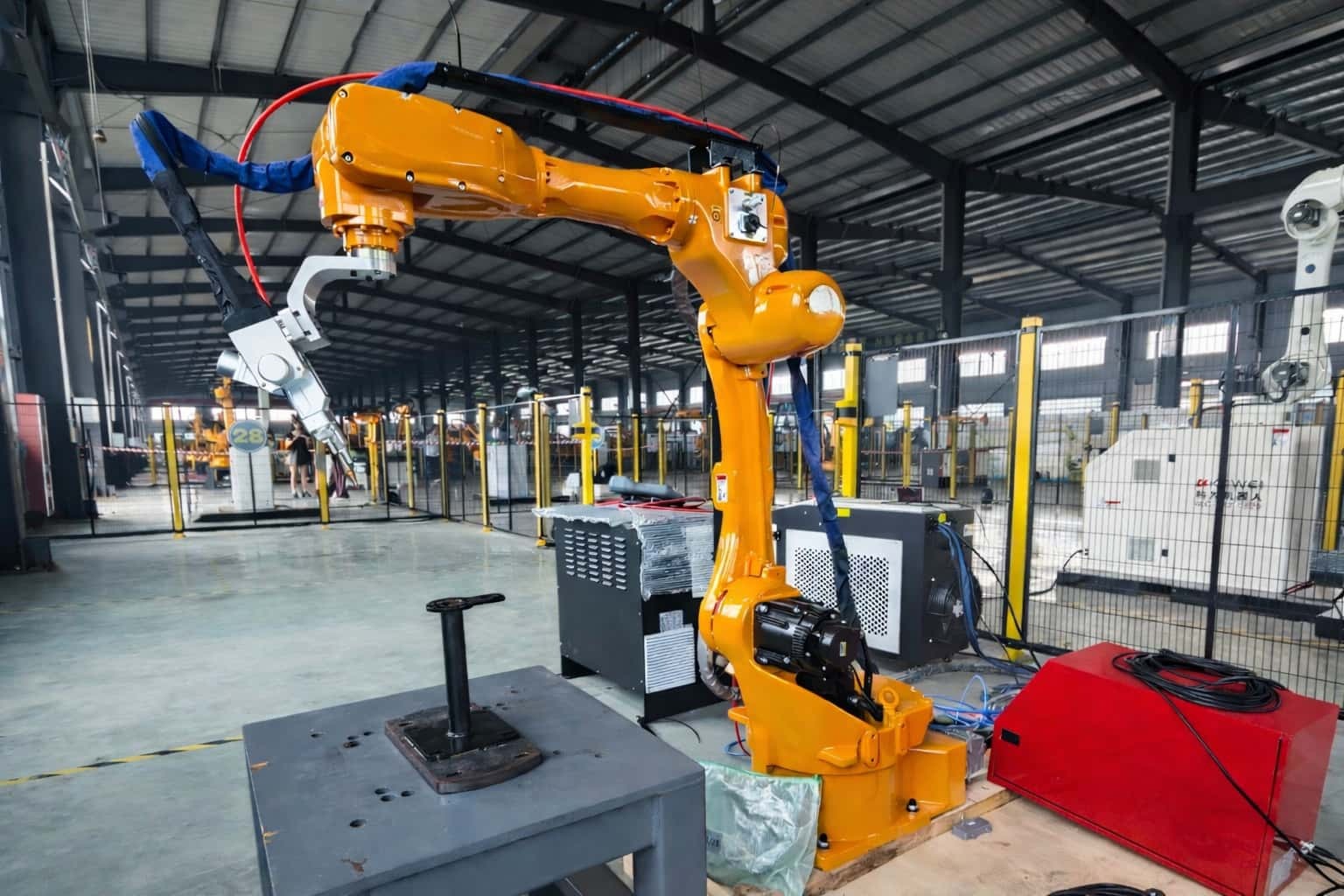
The KW1010B-1440 is a six-axis laser welding robot: 10 kg at the flange, 1440 mm of reach, and ±0.05 mm repeatability. It is built to carry a laser head and its wire feed into a fixture, hold the seam, and travel it at 0.5 m/min without the operator steering.
Continuous path control and 4.5 kVA of power capacity put it in the class of machine that runs a cell rather than a single joint. Stainless steel and aluminium alloy are the two materials the factory specifies, which covers cabinets, frames, trays and vessel work where the weld is left visible.
Key Features
1440 mm Reach
Long enough to work across a fixture without indexing the part between passes, short enough to stay stiff at the flange.
10 kg Payload
Head, optics, wire feeder and cabling all count against it. Ten kilos covers a laser head with filler wire, not just a bare torch.
±0.05 mm
Laser spots are small; a repeatability figure in hundredths of a millimetre is what keeps the focus point on the joint.
IP56 / IP67
Protection stated as equivalent to IP56 and IP67, so dust, spatter and coolant splash are expected rather than tolerated.
Application Areas
Stainless steel kitchen and sanitary ware, sheet-metal cabinets and enclosures, aluminium frames and profiles, elevator and door panels, battery trays, and the welding shops behind shipbuilding, furniture hardware, heavy machinery and boiler work.
Product Description
Ten Kilos on a 1440 mm Arm
Payload and reach are quoted together because they are spent together. A laser head, its optics, the wire feeder and the cable pack all hang off the flange, and the further the arm extends the less of that ten kilos is left for margin.
1440 mm is sized to a working cell: the robot reaches the far side of a fixture table and the corners of a cabinet panel without the part being re-clamped, so one program covers the whole seam.
Half a Metre a Minute, Held Steady
0.5 m/min is the welding speed, and it is the number the seam quality depends on. On continuous path control the arm interpolates the whole trajectory rather than stepping between taught points, so the feed rate stays flat through curves and corners.
That is what makes a laser seam repeatable: same speed, same focus distance, same shielding, seam after seam, shift after shift.
±0.05 mm, Because the Spot Is Small
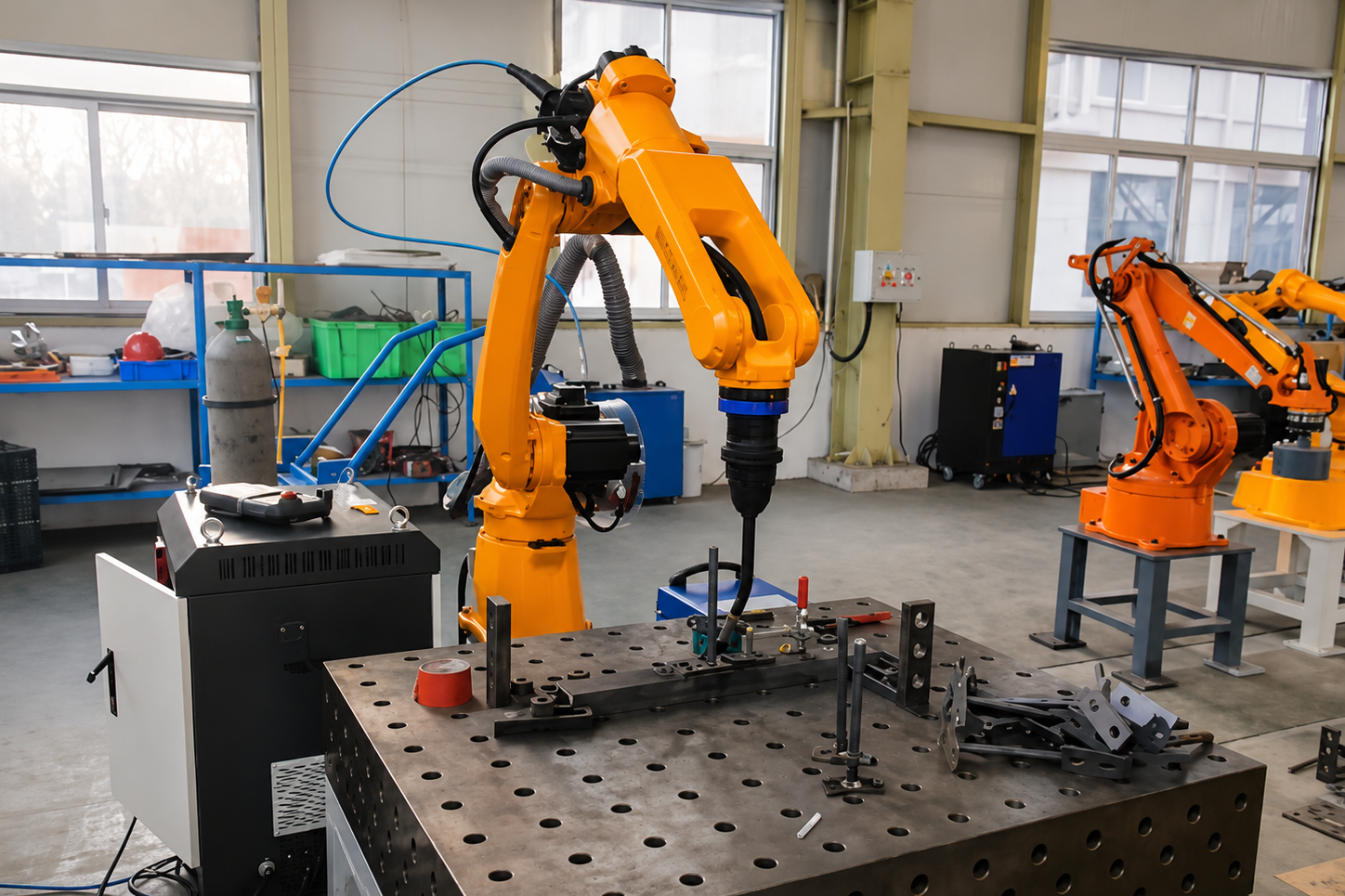
A laser weld is made by a spot a fraction of a millimetre across. TIG tolerates a hand that wanders; a laser does not. Position repeatability of ±0.05 mm is what lets the same program be recalled next week and land on the same joint.
J6 turns at up to 1353°/s while the wrist stays on path, which is how the head follows a tight radius without the arm winding up.
Stainless and Aluminium
The factory specifies this model for stainless steel, aluminium alloy and general metal components. Those are the materials where a laser earns its place: low heat input, a narrow heat-affected zone, and a bead that does not need grinding back before it is seen.
On aluminium the same machine is quoted with the head and the parameters matched to the alloy, because reflectivity and conductivity change the weld window — that matching is done at project stage, not at the panel.
ROI & Operational Value
A finished weld, not a weld to finish. Low heat input keeps distortion and spatter down, so the grinding and straightening pass after welding gets shorter or disappears.
0.5 m/min on continuous path. The travel speed is set once and repeated, which turns seam quality from a welder's judgement into a process parameter that can be logged.
±0.05 mm cuts rework. Repeatable position is what makes a first-pass yield figure possible on thin stainless and aluminium, where a missed joint is scrap rather than a touch-up.
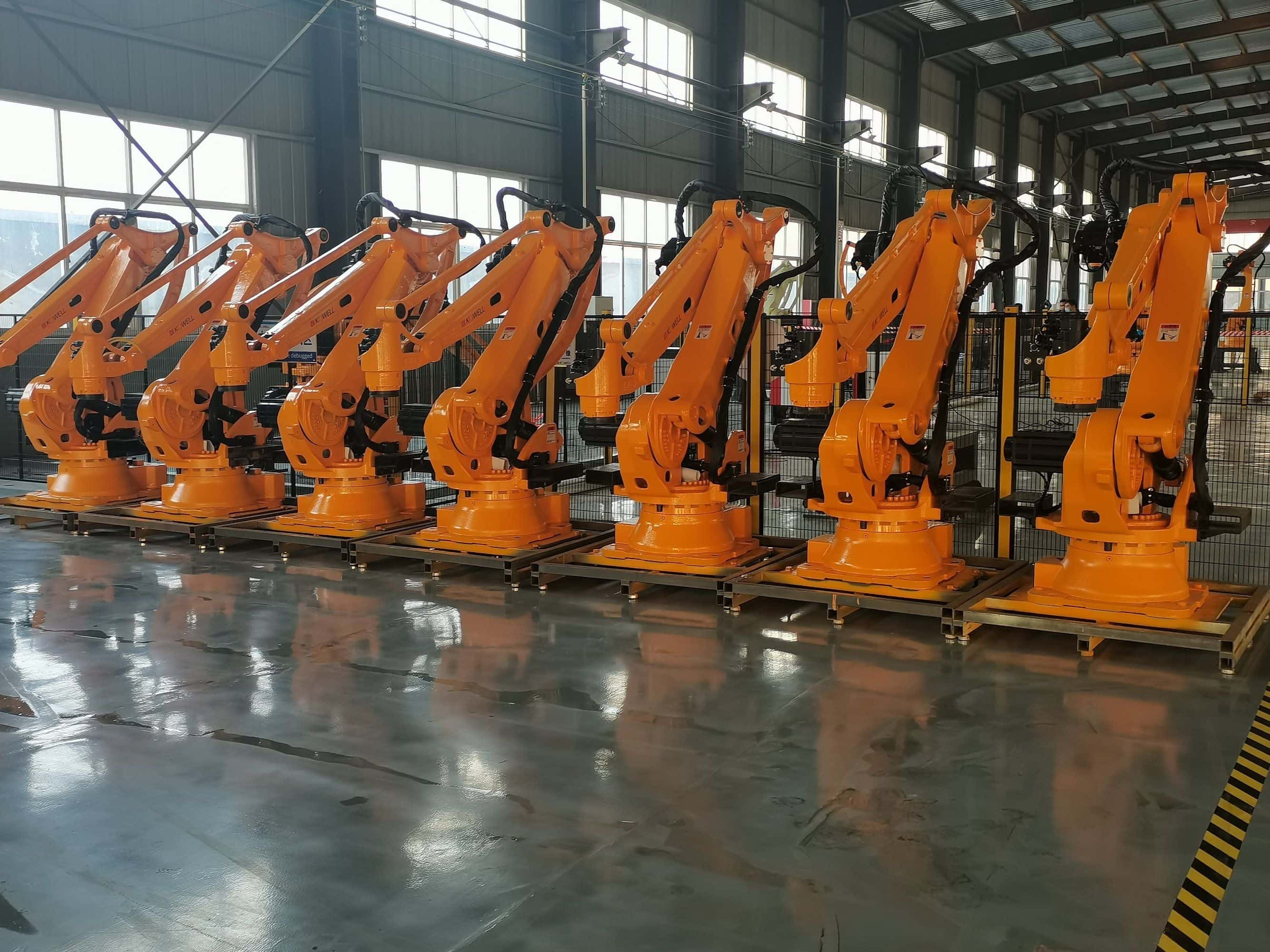
Retrofits into an existing cell. A 210 kg body on a ground mount, drawing 4.5 kVA, drops into a bay that already has a table and a fence instead of demanding a new building.
Technical Specifications
| Specification | KW1010B-1440 |
|---|---|
| Basic Parameters | |
| Robot Type | Laser welding robot |
| Robot Structure | Vertical joint, 6 degrees of freedom |
| Control Mode | Continuous path control |
| Drive Mode | Electric |
| Payload Capacity | 10 kg |
| Working Radius | 1440 mm |
| Position Repeatability | ±0.05 mm |
| Welding Speed | 0.5 m/min |
| Power Capacity | 4.5 kVA |
| Body Weight | 210 kg |
| Installation Method | Ground installation |
| Main Application | Laser welding of stainless steel, aluminium alloy and metal components |
| Motion Range & Speed | |
| J1 Axis Range / Speed | ±167° / 285°/s |
| J2 Axis Range / Speed | -145° to +80° / 247°/s |
| J3 Axis Range / Speed | -75° to +145° / 285°/s |
| J4 Axis Range / Speed | ±190° / 392°/s |
| J5 Axis Range / Speed | +50° to -210° / 272°/s |
| J6 Axis Range / Speed | ±220° / 1353°/s |
| Operating Reference | |
| Operating Temperature / Humidity | 0–45°C, 20–80% RH, non-condensing |
| Protection Level | Equivalent to IP56 / IP67 |
| Packaging Reference | |
| Package Size (L × W × H) | 200 × 200 × 200 cm |
Specifications are for the robot body. Final figures vary with laser source, welding head, fixture design, safety enclosure and project requirements.
FAQ
Which metals and joints is it meant for?
Stainless steel, aluminium alloy and general metal components, welded with a laser head. The factory names shipbuilding, furniture hardware, heavy machinery and boiler work as the industries it is built for.
Why does ±0.05 mm matter on a laser?
The focused spot is a fraction of a millimetre across, so any drift moves the weld off the joint instead of widening it. Repeatability in hundredths of a millimetre is what lets a stored program be recalled and run without re-teaching.
Can it be mounted overhead or inverted?
This model is quoted for ground installation. If the cell needs the arm hanging from a gantry or working inverted, tell us at enquiry stage — mounting method is fixed per platform and cannot be changed on site.
What environment can it work in?
0–45°C at 20–80% relative humidity, non-condensing, with protection stated as equivalent to IP56 / IP67. It expects a weld shop, not a clean room.
Is the laser source included?
The figures above describe the robot. Laser source, welding head, wire feed and enclosure are matched to the material and the seam at project stage, and quoted together with the arm.
How does it ship and what does the site need?
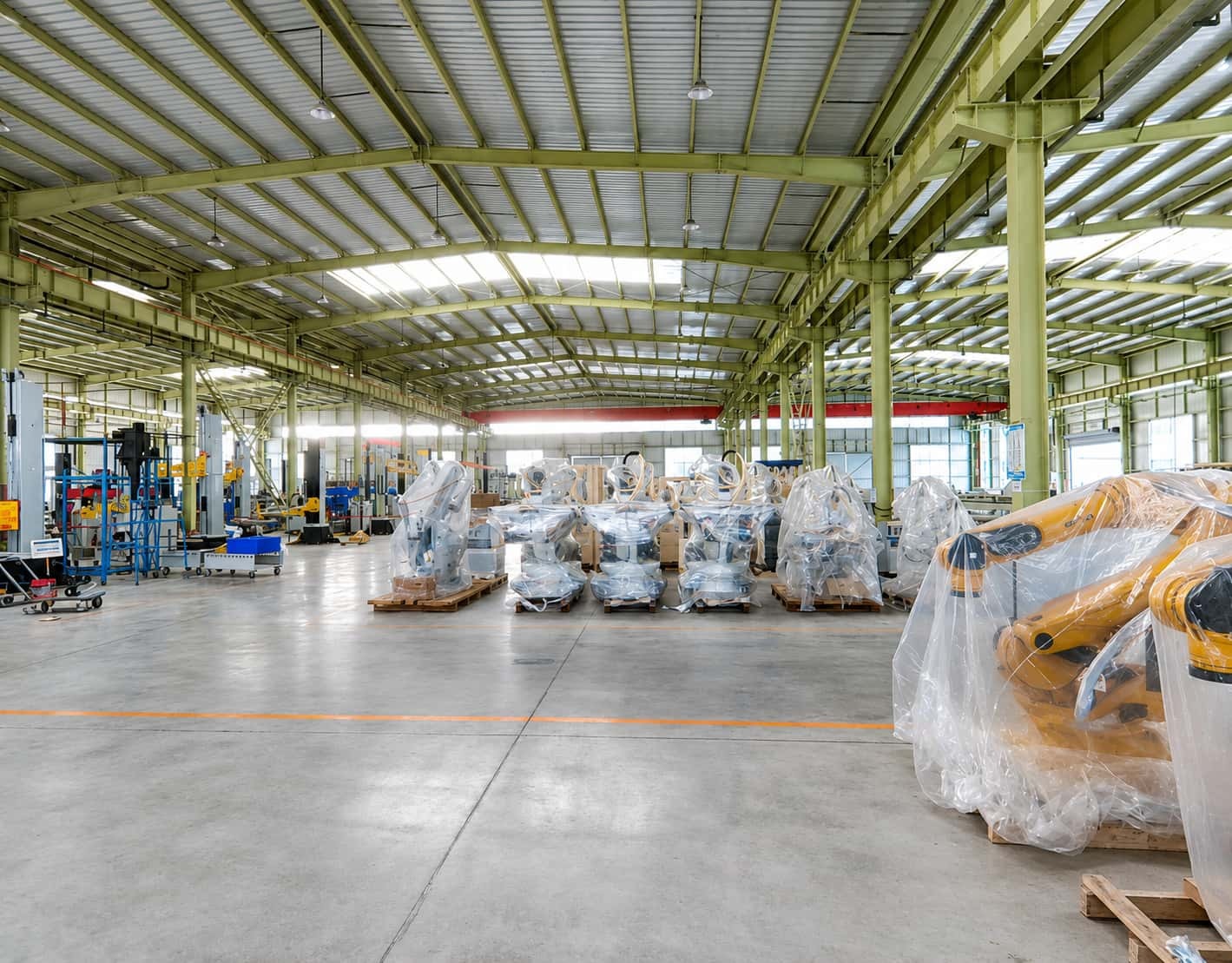
A 200 × 200 × 200 cm crate on a standard flatbed. On site it needs a level floor with anchor points, 4.5 kVA of power capacity, and clearance for the arm to reach the full 1440 mm radius.
Request a Quote
Send the material, the plate thickness and the joint drawing, and we will specify the laser head and the cell around the KW1010B-1440.
Contact UsAbout Robotmall
Robotmall is a global B2B robotics platform connecting manufacturers, technology partners and businesses worldwide. We support robot sourcing, solution evaluation, deployment coordination and after-sales services.
- Model:
- KW1010B-1440
- Payload:
- 10 kg
- Reach:
- 1440 mm
- Repeatability:
- +/-0.05 mm
- Welding Speed:
- 0.5 m/min
- Power:
- 4.5 kVA
- Weight:
- 210 kg
- Installation:
- Ground
- Protection:
- IP56/IP67
- Package:
- 2000x2000x2000 mm


