PC16 PC18 Mortar Spraying Machines with DERUTU PRO Plastering Robot
Write a Review

PC16 PC18 Mortar Spraying Machines with DERUTU PRO Plastering Robot
Product Overview
Three machines that do one job between them: PC16 and PC18 spray the mortar onto the wall, and DERUTU PRO flattens it. The two sprayers share a frame, a 92 L hopper and a 45 L/min output; what separates them is the motor, 7.5 kW against 9.2 kW.
The PRO is a different class of tool: a mast machine that climbs to 420 cm, lays an 110 cm wide pass at 4 m² per minute, and levels itself by microcomputer rather than by eye. Run a sprayer and the PRO together and the wall goes from a wet heap of mortar to a flat surface without a plastering gang setting screed rails first.
Model Lineup
Mortar Spraying
DERUTU PC16
7.5 kW on 380 V, 45 L/min, 50 m delivery, 92 L hopper, 288 kg.
The standard screw-pump unit for interior and exterior plastering.
Mortar Spraying
DERUTU PC18
9.2 kW on 380 V, same 45 L/min, same 50 m, same 92 L hopper.
The same machine with more motor behind the pump, for the heavier mixes.
Auto Plastering
DERUTU PRO
420 cm height, 110 cm width, 4 m²/min, servo drive, two battery packs.
The levelling half of the pair — works alongside either sprayer.
Key Features
45 L/min, 50 m
Both sprayers hold 5.5 bar and push material 50 m from the hopper, in a 92 L tank that takes aggregate up to 6 mm.
Screw Pump
Rotor-and-stator displacement rather than piston: steady pressure, fewer pulsations at the nozzle, and a pump that handles gypsum as readily as cement mortar.
4 m² a Minute
The PRO lays a 110 cm pass at 4 m²/min and lifts to 420 cm, so a full-height wall is done in one setup instead of a scaffold build.
Self-Levelling
Microcomputer levelling on a servo-driven mast, running from two battery packs for a full 8-hour shift without a cable up the wall.
Application Areas
Interior wall plastering, exterior wall plastering, self-levelling floor screeds and material transfer, in cement mortar, ready-mixed and finished mortar, gypsum and concrete — plus thick-layer fireproof coating with the PRO, which also handles mortar and gypsum on the same mast.
Product Description
Two Sprayers, One Frame
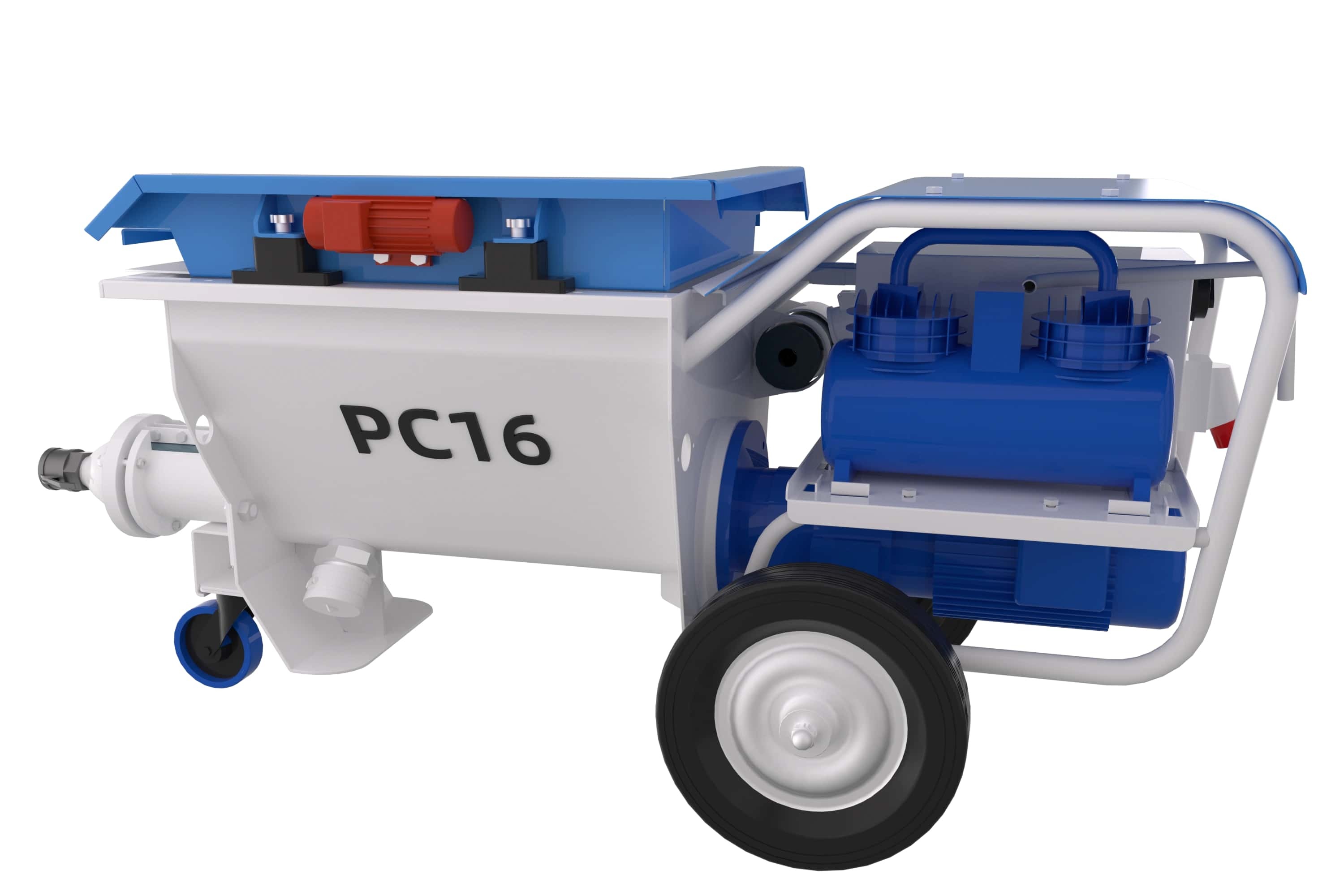
The factory sheet makes the choice unusually simple. PC16 and PC18 share the frame at 145 × 80 × 90 cm, share the 288 kg weight, the 92 L hopper, the 45 L/min output, the 5.5 bar working pressure and the 50 m delivery distance. The single listed difference is the motor: 7.5 kW against 9.2 kW.
That 1.7 kW buys headroom rather than headline flow — it is what keeps a stiff mix moving through 50 m of hose when the run is long and the material is heavy. For standard interior work on a normal hose length, PC16 does the same job with a smaller supply.
The Bigger Motor
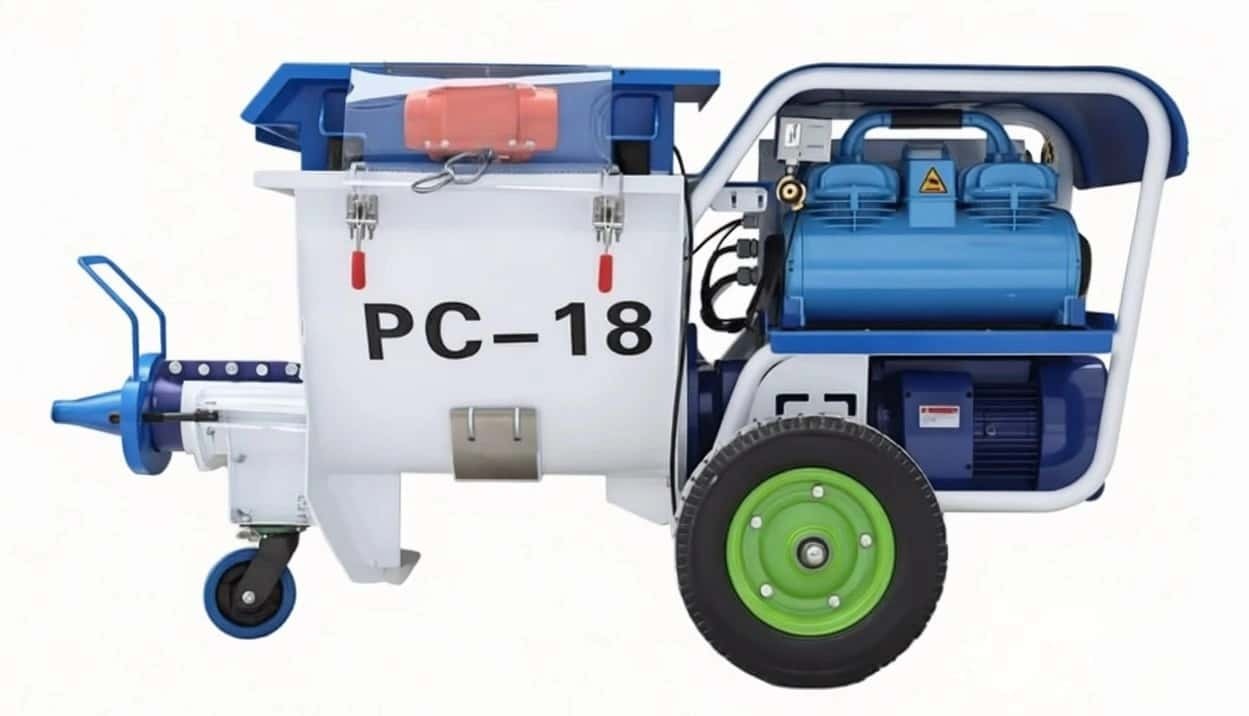
PC18 is the same chassis with the 9.2 kW motor. Where the mix is dense, the hose is long, or the crew is pushing output to keep a floor programme on schedule, that margin matters more than the spec sheet suggests.
Both units run on 380 V three-phase and both need two people: one at the hopper feeding and watching the mix, one at the nozzle. Neither is a one-man tool, and quoting them as one is how sites end up short-handed.
Then the Wall Gets Flattened
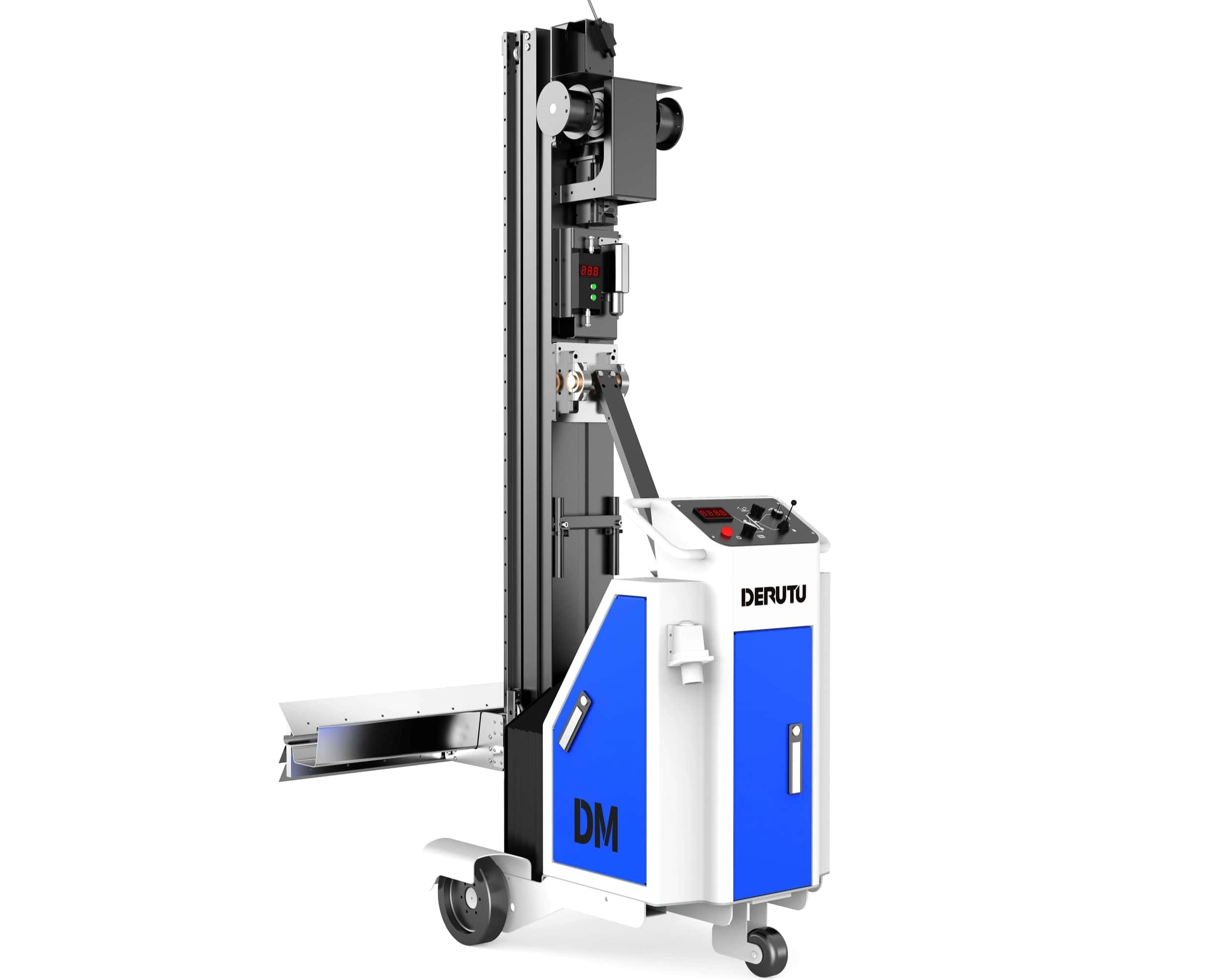
DERUTU PRO is the other half of the workflow. It climbs a ball-screw mast, spreads the mortar with a 110 cm blade at 4 m² per minute, and levels itself by microcomputer — the operator sets the wall, not the thickness. Material goes on between 3 and 30 mm.
It runs on two battery packs for an 8-hour shift at 252 kg, so no lead is dragged up the wall and no generator sits in the room. One or two people can work it, where the manual alternative is a trowel crew working the same elevation by hand.
ROI & Operational Value
240 m² an hour of levelling. 4 m² per minute is the figure a plastering programme is costed on, and it does not depend on how fresh the gang is at four in the afternoon.
No screed rails to set. Self-levelling removes the screed-rail step before spraying and the hand trowelling after it — two operations that normally book a second trade onto the same wall.
Surplus goes back in the hopper. Material scraped off during levelling can be re-sprayed rather than binned, which is a direct materials saving on every elevation.
Two people, one wall. Sprayer plus PRO at 1–2 operators, where the manual route is a trowel crew on the same elevation — and the battery drive keeps the work area free of leads.
Technical Specifications
| Parameter | PC16 | PC18 | DERUTU PRO |
|---|---|---|---|
| General | |||
| Machine Type | Mortar spraying | Mortar spraying | Auto plastering |
| Pump Technology | Screw pump (DE 6.1) | Screw pump (specially made) | — |
| Motor | 7.5 kW | 9.2 kW | Servo motor |
| Power Supply | 380 V | 380 V | 2 battery packs, 8 h runtime |
| Control / Positioning | Physical buttons | Physical buttons | Microcomputer auto-levelling |
| Performance | |||
| Max Output | 45 L/min | 45 L/min | 4 m²/min |
| Working Pressure | 5.5 bar | 5.5 bar | — |
| Max Aggregate Size | <6 mm | <6 mm | — |
| Delivery Distance | 50 m | 50 m | — |
| Plastering Height | — | — | 420 cm |
| Plastering Width | — | — | 110 cm |
| Plastering Thickness | — | — | 3–30 mm |
| Capacity & Physical | |||
| Hopper Capacity | 92 L | 92 L | — |
| Dimensions (L × W × H) | 145 × 80 × 90 cm | 145 × 80 × 90 cm | 120 × 69 × 205 cm |
| Weight | 288 kg | 288 kg | 252 kg |
| Crew Required | 2 people | 2 people | 1–2 people |
| Materials | |||
| Compatible Materials | Cement mortar, ready-mixed and finished mortar, gypsum, concrete | Cement mortar, ready-mixed and finished mortar, gypsum, concrete | Mortar, gypsum, thick-layer fireproof coating |
Figures are the manufacturer's published values for each model. The PRO runs alongside either sprayer to complete a spray-and-smooth cycle; it is not a spraying machine and does not replace one.
FAQ
PC16 or PC18 — what actually differs?
The motor: 7.5 kW against 9.2 kW. Frame, hopper, output, pressure, delivery distance and weight are the same on the factory sheet. Buy the 18 when the mixes are heavy or the hose run is long; the 16 covers standard interior work.
Do I need both a sprayer and the PRO?
If the job is spray-and-smooth, yes. The sprayer puts material on the wall; the PRO levels and finishes it. The PRO does not spray, and a sprayer alone leaves the trowelling to a person.
What can the sprayers actually pump?
Cement mortar, ready-mixed and finished mortar, gypsum and concrete, with aggregate up to 6 mm, delivered through 50 m of hose at 45 L/min and 5.5 bar.
What does the PRO need on site?
A level floor to run its castors on, a wall clear to 420 cm, and two battery packs for an 8-hour shift. No cable up the wall and no 380 V supply at the face.
How thick a coat can the PRO lay?
Between 3 and 30 mm in one pass, in an 110 cm wide strip, levelled by microcomputer rather than by the operator's eye.
How many people does a crew need?
Two on either sprayer — one feeding the hopper, one on the nozzle. One or two on the PRO. The pair together is still a smaller crew than a manual plastering gang for the same elevation.
Request a Quote
Tell us the wall area, the material and the number of floors, and we will size the sprayer and the plastering unit as one package.
Contact UsAbout Robotmall
Robotmall is a global B2B robotics platform connecting manufacturers, technology partners and businesses worldwide. We support robot sourcing, solution evaluation, deployment coordination and after-sales services.
- Lineup:
- PC16
- DERUTU PRO|Spray Output:
- 45 L/min|Pressure=5.5 bar|Delivery=50 m|Hopper=92 L|Plastering Height=420 cm|Plastering Width=110 cm|Plastering Output=4 m2/min|Power=380 V or battery|Weight=288 / 288 / 252 kg