


HUTT Window Cleaning Robot Lineup: A1, W9 Pro, C7, DDC55 Pro
Rédiger un avis

HUTT Window Cleaning Robot Lineup: A1, W9 Pro, C7, DDC55 Pro
Product Overview
Four window cleaning robots on one page: HUTT A1, W9 Pro, C7 and DDC55 Pro. Same principle on all of them — negative pressure holds the machine to the glass while a motorised pair of pads wipes it — but they are built to four different briefs, from an entry unit for everyday home windows to a 14.1 cm flagship that turns sideways to reach a 29 cm pane.
Suction runs from 5,400 Pa to 6,000 Pa across the four. Three are mains-powered; the W9 Pro carries a 5,000 mAh battery so no socket sets the limit. Every model is rated for frameless and tilted glazing, and each carries a mechanical safety rope rated to 148 kg.
Model Lineup
Entry
HUTT A1
Everyday home use. 6,000 Pa, 150 ml tank, 90 m² per fill, 99.5% coverage.
Best for routine cleaning on ordinary domestic glass.
Mid-range
HUTT W9 Pro
Cordless freedom. 5,000 mAh battery, 200 ml tank, 6,000 Pa, 90 m² per fill.
Best for buildings where the nearest socket is in the next room.
Advanced
HUTT C7
Deep stain removal. 55 N floating press, 70 RPM discs, 5,500 Pa, 99% coverage.
Best for bird droppings, limescale and windows left too long.
Flagship
HUTT DDC55 Pro
Multi-surface pro. 14.1 cm body, 29 cm narrow panes, 150 m² per fill, 8-layer safety.
Best for awkward glazing, narrow panes and delicate wallcoverings.
Key Features
5,400–6,000 Pa
Brushless fans pulling negative pressure against the pane. The figure is peak suction, held across all four models within that band.
HUTTHINK Routes
HUTT-SLAM 4.0 maps the pane and picks the path per surface; C7 runs the newer HUTTHINK 5.0 build at 99% coverage.
Held, Not Balanced
0.03–0.04 s pressure compensation, 20–30 min of hold after power loss, 13 sensors and a 148 kg rope.
CQC, 30 Checks
Every model is CQC certified and put through 5 functional, 12 component, 10 performance and 5 sampling tests.
Application Areas
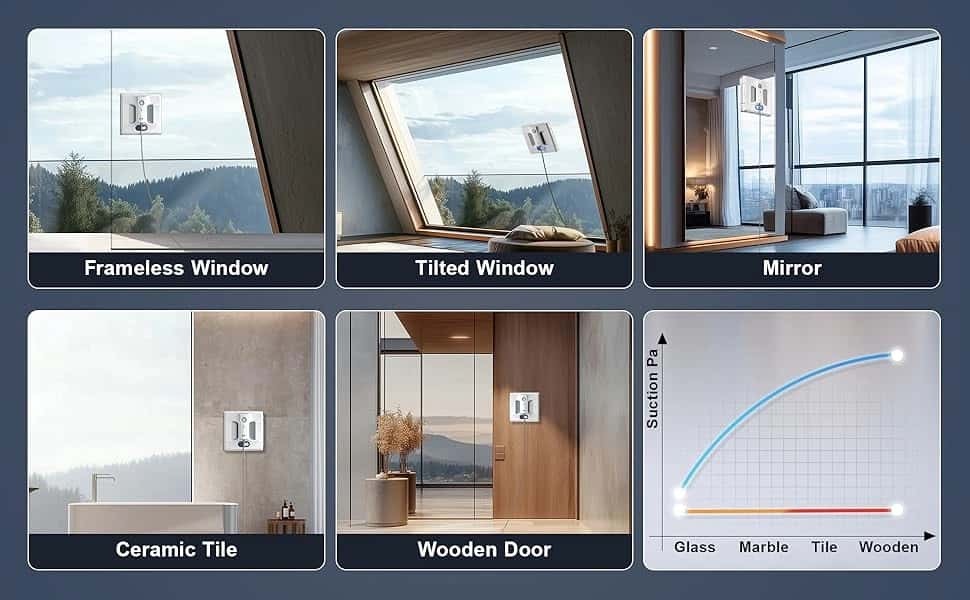
Frameless and tilted glazing, ordinary domestic windows, mirrors and glass doors, ceramic tiled walls, wooden doors and other flat vertical surfaces — the four models cover the same list, and differ in how much pane they can reach and how hard they press.
Product Description
Four Robots, One Family
The lineup is easier to read as a ladder than as a list. A1 is the entry unit: mains-powered, 150 ml, 90 m² on a fill, and 99.5% coverage with a dedicated edge pass that lifts corner cleaning by 50%.
From there each step buys something specific — the W9 Pro buys battery, the C7 buys pressure, the DDC55 Pro buys geometry. Nothing in the range changes material or principle, so a mixed fleet is trained once.
The One Without a Cable
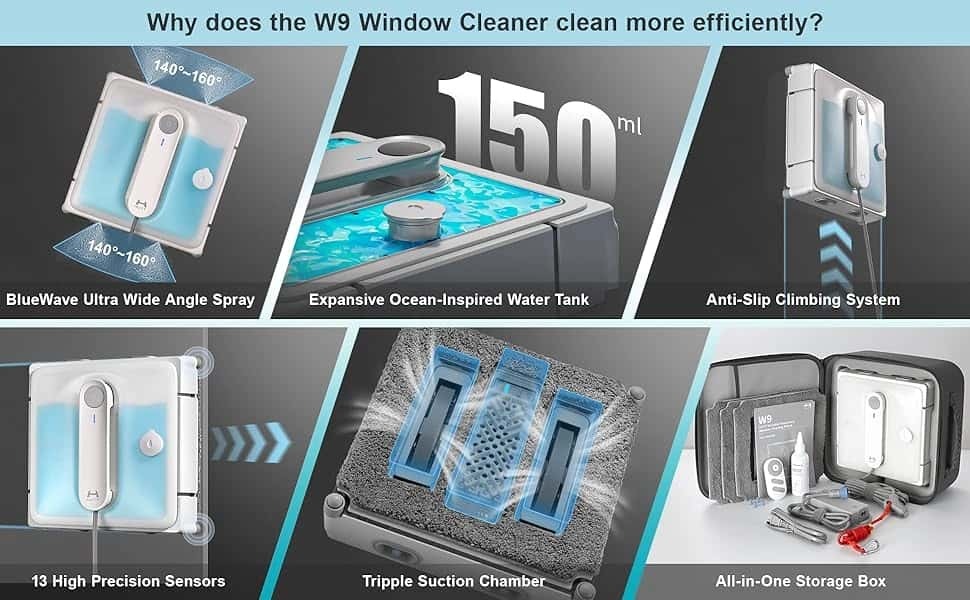
The W9 Pro is the only model here that runs from its own pack: 5,000 mAh of vehicle-grade cells, so the machine goes where the lead cannot follow. It carries a 200 ml tank — the largest in the range — and still covers 90 m² on one fill.
Its spray is the whale-rain pattern, sustained rather than pulsed, which keeps the pad wet across the whole pass. HUTT-SLAM 4.0 reads the surface and switches strategy between tiled walls and wooden doors.
Pressure, Then Geometry
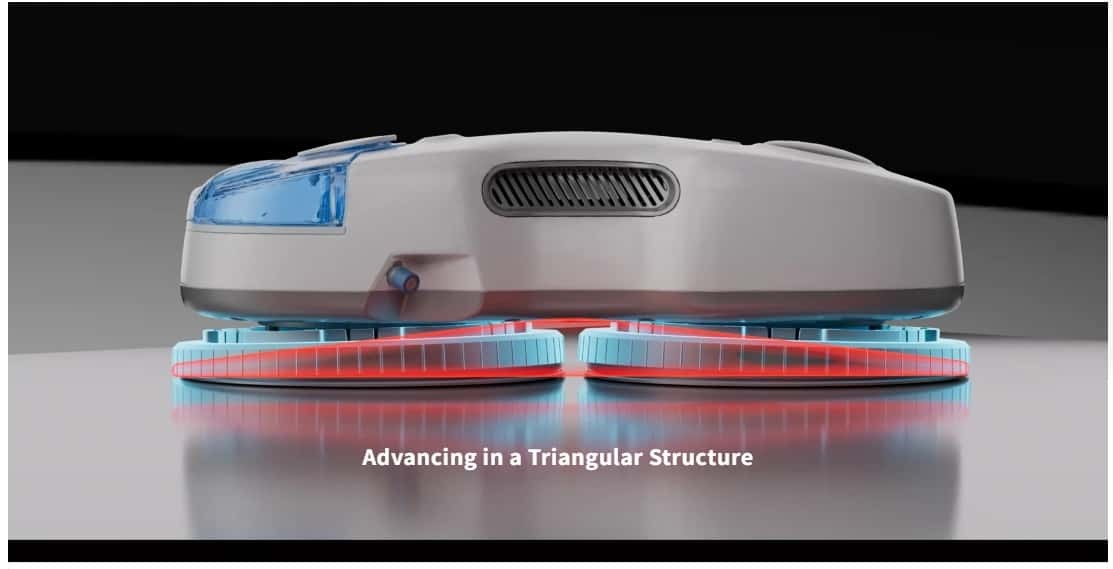
The C7 attacks dirt rather than area: a 3D suspension chassis pushes 55 N onto the glass, two independent discs spin at 70 RPM, and a 120° V-spray delivers 20 µm droplets so the water does not blow away before it works. 5,500 Pa holds it while it does.
The DDC55 Pro solves the other problem. At 14.1 cm it slides into a 29 cm pane, the floating chassis follows wallcoverings and rippled glass, the edge pass reaches zero distance into the frame, and safety goes to eight layers with 30 minutes of hold after a power cut.
Technical Specifications
| Specification | HUTT A1 | HUTT W9 Pro | HUTT C7 | HUTT DDC55 Pro |
|---|---|---|---|---|
| Positioning | ||||
| Best For | Everyday home use | Cordless freedom | Deep stain removal | Multi-surface pro |
| Grade | Entry | Mid-range | Advanced | Flagship |
| Cleaning Performance | ||||
| Suction Power | 6,000 Pa | 6,000 Pa | 5,500 Pa | 5,400 Pa |
| Water Tank | 150 ml | 200 ml | 80 ml | 80 ml |
| Area per Fill | 90 m² | 90 m² | — | 150 m² |
| Coverage Rate | 99.5% | — | 99% | — |
| Cleaning RPM | — | — | 70 RPM | — |
| Pressurization | — | — | 55 N | Floating adaptive |
| Spray System | Dual-direction pulse | Whale Rain Spray | 120° V-shape, 20 µm | Cone wide-angle pulse |
| Intelligence | ||||
| Path Planning | Smart Routing | HUTT-SLAM 4.0 | HUTT-SLAM 4.0 | Smart Routing |
| AI Algorithm | HUTTHINK | HUTTHINK | HUTTHINK 5.0 | HUTTHINK |
| Sensors | 13 | 13 | 13 | Multi-sensor array |
| Edge Cleaning | 50% improvement | Smart edge | Smart edge | Zero-distance |
| Safety | ||||
| Power-off Protection | 20 min | 20 min | 20 min | 30 min |
| Pressure Compensation | 0.03 s | 0.03 s | 0.03 s | 0.04 s |
| Safety Rope | 148 kg | 148 kg | 148 kg | 148 kg |
| Safety Layers | 5-layer | 5-layer | 5-layer | 8-layer |
| Unique Safety Feature | Rubber anti-slip track | 1+2 negative pressure chamber (+200%) | Triangular chassis | 3D floating chassis |
| Power & Mobility | ||||
| Power Source | Wired | Battery 5,000 mAh | Wired | Wired |
| Motor | Upgraded brushless | — | Independent dual motor | Independent dual motor |
| Body Thickness | — | — | — | 14.1 cm |
| Min Window Width | — | — | — | 29 cm |
| Climbing Ability | — | — | +30% vs previous gen | +30% vs previous gen |
| Certification & Quality | ||||
| Certification | CQC | CQC | CQC | CQC |
| Quality Tests | 30 | 30 | 30 | 30 |
| Cable Design | 2-in-1, anti-tangle | 2-in-1, anti-tangle | 2-in-1, anti-tangle | — |
Figures are the manufacturer's published values for each model. Suction is quoted as peak; area per fill depends on glass condition and cleaning mode.
FAQ
Which of the four should I order?
Take the A1 for ordinary home windows, the W9 Pro if the glass is far from a socket, the C7 if the dirt is heavy and the pane is flat, and the DDC55 Pro if the glazing is narrow, uneven or wrapped in wallpaper you would rather not mark.
Is the cordless one weaker?
No. The W9 Pro is rated at 6,000 Pa, the top of the range, and carries the largest tank at 200 ml. Its limit is running time, not suction, so it suits a room-by-room job rather than a full facade in one pass.
What keeps it on the glass if the power fails?
Four things in series: pressure compensation in 0.03–0.04 s, a hold of 20 minutes (30 on the DDC55 Pro) after the supply drops, a mechanical rope rated to 148 kg, and an audible alarm. The layers are counted as five on the first three models and eight on the flagship.
Will it handle frameless or tilted glazing?
Yes — frameless and tilted windows are part of the stated application list, handled by the edge sensors. On a frameless pane the machine stops at the glass edge rather than relying on a frame to catch it.
Does it clean anything besides windows?
The list extends to mirrors, glass doors, ceramic tiled walls and wooden doors. The DDC55 Pro goes further with a floating chassis that follows wallcoverings and rippled glass; the other three are happiest on flat surfaces.
What does “30 quality tests” actually mean?
Per model: 5 functional tests, 12 component tests, 10 finished-product performance tests and 5 ex-works sampling tests, under CQC certification.
Request a Quote
Tell us the window types, the floor count and the quantities per model, and we will build the mix and the landed price around it.
Contact UsAbout Robotmall
Robotmall is a global B2B robotics platform connecting manufacturers, technology partners and businesses worldwide. We support robot sourcing, solution evaluation, deployment coordination and after-sales services.
- Lineup:
- A1
- DDC55 Pro|Suction:
- 5400-6000 Pa|Tank=80-200 ml|Power=Wired or Battery 5000 mAh|Area per Fill=90-150 m2|Certification=CQC


