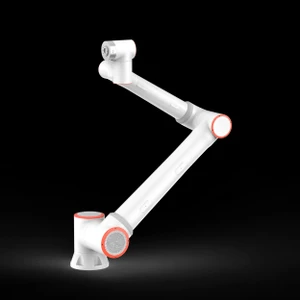
Z-Arm XX32, XX42 & XX42B 4-Axis Collaborative Robots
Escribir una reseña
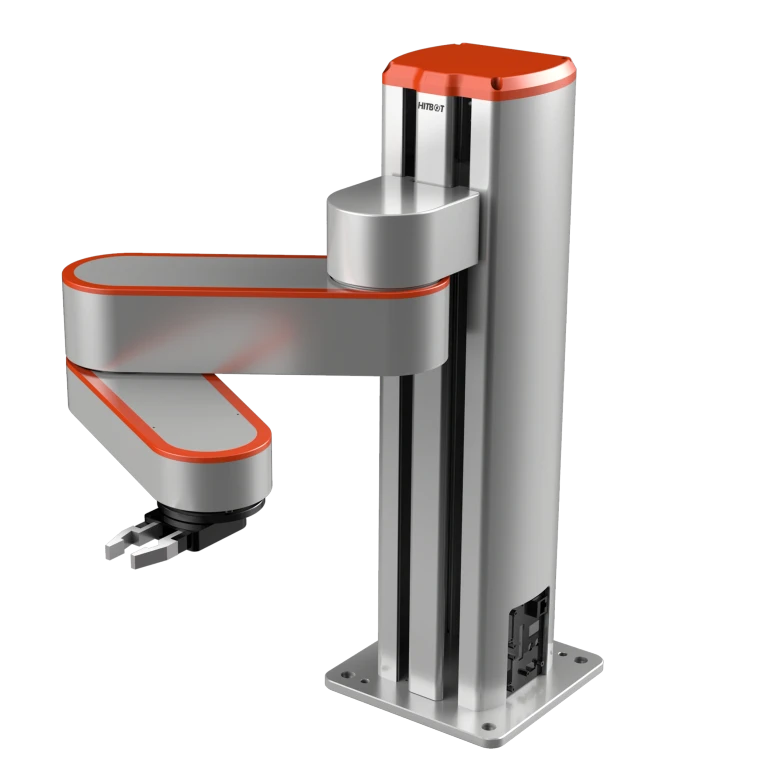
Z-Arm XX32, XX42 & XX42B 4-Axis Collaborative Robots
Product Overview
The Z-Arm XX32, XX42 and XX42B are the three small sizes of HITBOT's four-axis SCARA line — 320 mm, 420 mm and 420 mm of reach, from 0.5 kg to 4 kg rated payload, all on the same drive-and-control-in-arm architecture. Domestic model numbers are 1832, 2442 and 2442B.
All three draw 500 W from a 110–220 V supply and run on a 24 V DC bus, which is why they are the arms that end up on laboratory benches and test stations rather than machine frames. The XX32 is the micro arm at 11 kg; the XX42 adds reach and payload at 19 kg; the XX42B takes the same 420 mm envelope to 4 kg rated and ±0.02 mm.
Key Features
320 mm or 420 mm Reach
160 + 160 mm arms and a 180 mm Z stroke on the XX32; 220 + 200 mm arms and 240 mm of Z on the XX42 and XX42B. The R axis turns ±1080° on all three.
±0.02 mm on Two of Three
The XX32 and XX42B both hold ±0.02 mm; the XX42 sits at ±0.03 mm. Cycle times run from 2.28 s on the small arm down to 1.895 s on the B.
11 kg, Four Screws, 24 V
The XX32 is about 11 kg bare on a 200 × 200 mm plate with a 160 × 160 mm hole pattern. It mounts where a machine-tool arm never could.
Collision Detection on XX32 and XX42
HITBOT lists collision detection and drag teaching as fitted on the XX32 and XX42; both rows are blank on the XX42B. Hard e-stop and USB debugging are standard on all three.
Application Areas
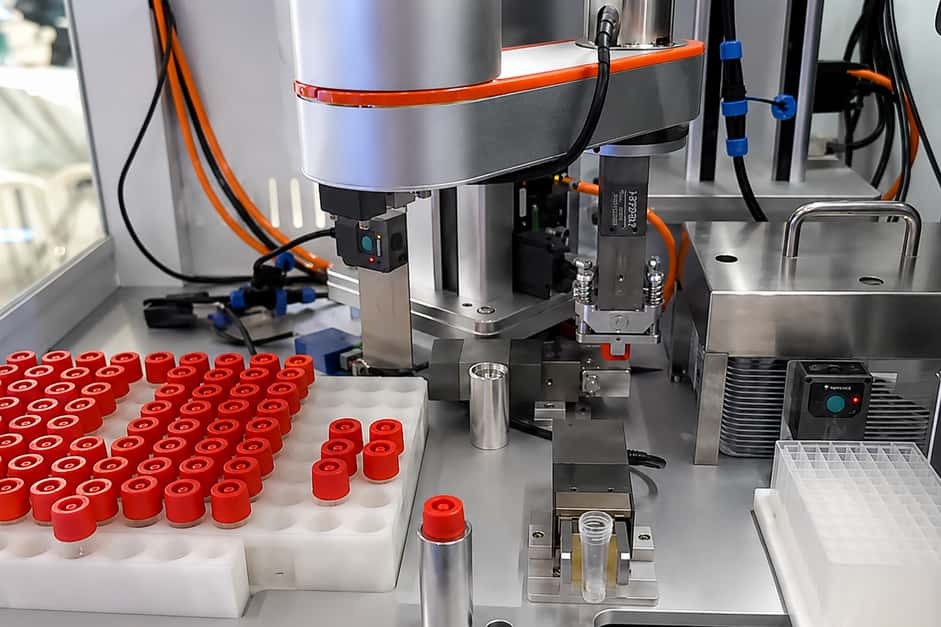
Micro-assembly and screw fastening in 3C electronics; small-part pick and place; adhesive dispensing; laboratory liquid handling and tube transfer; test-station loading; educational and R&D benches where the cell is rebuilt often. All three are indoor units specified to 0–45 °C and 20–80 % RH non-condensing. No IP rating is published for any model in the series, so none of them is a washdown or machine-shop arm.
Model Lineup
Micro · 0.5 kg
Z-Arm XX32
320 mm reach · 0.5 kg rated · ±0.02 mm · 2.28 s · 500 W / 24 V · approx. 11 kg
For sub-bench automation: inside instruments, above a balance, beside a microscope. The lightest and smallest arm in the range, yet it keeps ±0.02 mm and collision detection.
Compact · 2 kg
Z-Arm XX42
420 mm reach · 2 kg rated · ±0.03 mm · 2.066 s · 500 W / 24 V · approx. 19 kg
The volume model of the small range: real reach for test handling and dispensing, forearm I/O expansion with a dedicated gripper port, collision detection fitted.
Compact · 4 kg
Z-Arm XX42B
420 mm reach · 4 kg rated · ±0.02 mm · 1.895 s · 500 W / 24 V · approx. 27 kg
Same 420 mm envelope as the XX42, carrying twice the payload at the tightest accuracy and the fastest cycle — but with no drag teaching and no collision detection listed, and the XX60 bolt pattern.
Gallery


Product Description
The Micro Arm That Behaves Like an Instrument
The XX32 exists for the places a robot normally cannot go: 160 + 160 mm arms, a 180 mm Z stroke, about 11 kg bare, a 200 × 200 mm base on four M5 screws. It draws 500 W at 24 V DC and still holds ±0.02 mm with collision detection and drag teaching fitted.
The trade is payload — 0.5 kg rated, 1 kg maximum — which is exactly right for vial handling, small optical parts and sensor assemblies, and wrong for anything holding a gripper with real mass. Its base and flange match the domestic Z-Arm 1632.


XX42 to XX42B: Same Envelope, Different Machine
The two 420 mm arms share arm lengths, rotations and Z stroke. The B swaps accuracy headroom for payload: 4 kg rated instead of 2 kg, ±0.02 mm instead of ±0.03 mm, and a 1.895 s cycle against 2.066 s. It moves to the 250 × 250 mm base and the XX60 bolt pattern, so a cell laid out for an XX42B can later take a 600 mm XX60 without re-drilling.
The other difference is on the safety sheet: collision detection and drag teaching are listed as fitted on the XX42 and blank on the XX42B. If either matters to your cell, specify the XX42 or get the B's configuration confirmed in writing before order.
I/O, Z Heights and What Ships
The XX42 and XX42B bring out 8 in / 8 out at the forearm plus a dedicated gripper port that takes a pulse or RS485 signal, with 23 AWG unshielded cable standard and two φ4 mm air tubes as an option; the XX32 carries the base 9 + 3 inputs. Custom Z-axis height runs 0.1–0.8 m on the XX32 and 0.1–1 m on the 42 pair, chosen at order.
In the box: the arm, its power supply and the mounting screws. Not in the box: gripper, camera, vision, safety device, cell frame. IP rating and noise figures are not published anywhere in the series, so plan the environment accordingly.

ROI & Operational Value
1,580 to 1,902 cycles an hour, arm-only. Straight from the quoted 2.28 s, 2.066 s and 1.895 s figures. Real output drops once part transfer and vision are added, but the ranking between the three arms holds.
50 % payload headroom on every model. 0.5 kg rated against 1 kg maximum, 2 against 3, 4 against 5. A gripper and its air line come out of that, so size the tool against the rated figure — the maximum is a limit, not a target.
A bench install, not a machine build. 11 to 27 kg, four screws, 24 V DC. One person positions an XX32, and the low-voltage supply keeps the power side of the install at brick level rather than panel level — that is what puts a robot on a lab bench without a machine-room budget.
A growth path with one bolt pattern. XX42B shares base and flange with the XX60; XX42 shares its flange family with the domestic 2140; XX32 matches the 1632. Moving up the range as takt demands means re-arming the cell, not rebuilding it.
Technical Specifications
| Parameter | Z-Arm XX32 | Z-Arm XX42 | Z-Arm XX42B |
|---|---|---|---|
| Kinematics | |||
| Axis 1 Arm Length | 160 mm | 220 mm | 220 mm |
| Axis 1 Rotation | ±90° | ±90° | ±90° |
| Axis 2 Arm Length | 160 mm | 200 mm | 200 mm |
| Axis 2 Rotation | ±143° | ±164° (option 15–345°) | ±164° (option 15–345°) |
| Z-Axis Stroke | 180 mm | 240 mm | 240 mm |
| R-Axis Rotation | ±1080° | ±1080° soft limit / ±170° mechanical | ±1080° soft limit / ±170° mechanical |
| Degrees of Freedom | 4 | 4 | 4 |
| Performance | |||
| Linear Speed | 1,017 mm/s at 0.5 kg | 1,220 mm/s at 2 kg | 1,600 mm/s at 4 kg |
| Cycle Time | 2.28 s | 2.066 s | 1.895 s |
| Repeat Positioning Accuracy | ±0.02 mm | ±0.03 mm | ±0.02 mm |
| Rated Payload | 0.5 kg | 2 kg | 4 kg |
| Maximum Payload | 1 kg | 3 kg | 5 kg |
| Electrical & Control | |||
| Rated Power | 500 W | 500 W | 500 W * |
| Input Voltage | 110–220 V, 50/60 Hz | 110–220 V, 50/60 Hz | 110–220 V, 50/60 Hz |
| Output Voltage | DC 24 V | DC 24 V | DC 24 V * |
| Communication | Ethernet | Ethernet | Ethernet |
| Physical & Mounting | |||
| Overall Height | 500 mm | 596 mm | 683 mm |
| Weight (bare, standard stroke) | approx. 11 kg at 180 mm | approx. 19 kg at 240 mm | approx. 27 kg at 240 mm |
| Base Dimensions | 200 × 200 × 10 mm | 200 × 200 × 10 mm | 250 × 250 × 15 mm |
| Mounting Holes | 160 × 160 mm, 4 × M5 × 12 | 160 × 160 mm, 4 × M8 × 20 | 200 × 200 mm, 4 × M8 × 20 |
| Custom Z-Axis Height | 0.1–0.8 m | 0.1–1 m | 0.1–1 m |
| Operating Environment | 0–45 °C, 20–80 % RH non-condensing | 0–45 °C, 20–80 % RH non-condensing | 0–45 °C, 20–80 % RH non-condensing |
| I/O & Interface | |||
| Digital I/O (isolated) | 9 + 3 | 9 + 3, plus forearm expansion 8 in / 8 out; gripper port pulse or RS485 | 9 + 3, plus forearm expansion 8 in / 8 out; gripper port pulse or RS485 |
| Analog I/O (4–20 mA) | — | — | — |
| Reserved Interface | — | Standard: cable gland, 2 × 4×23 AWG unshielded. Option: 2 × φ4 mm air tube | Standard: cable gland, 2 × 4×23 AWG unshielded. Option: 2 × φ4 mm air tube |
| Safety & Programming | |||
| Collision Detection | Yes | Yes | — |
| Drag Teaching | Yes | Yes | — |
| Hard Emergency Stop | Yes | Yes | Yes |
| USB Debug / Online Upgrade | Yes | Yes | Yes |
| Base Compatibility | Same base as Z-Arm 1632 | — | Same base as Z-Arm XX60 |
| Flange Compatibility | Z-Arm 1632 flange | Z-Arm 2140 flange | Z-Arm XX60 flange |
— means the manufacturer publishes no value for that item; it does not mean zero or unsupported. Cycle times are arm-only, quoted without part transfer or vision time. * The XX42B power row follows HITBOT's own XX42B page (500 W, DC 24 V); HITBOT's comparison table instead lists 2,000 W and DC 48 V for the same model — we will confirm the shipped configuration in writing before order.
Cycle times for the XX42 and XX42B come from the product comparison table; the manufacturer's own pages leave that row blank. The XX42 flange row (Z-Arm 2140) likewise comes from the comparison table. All other values are quoted from the manufacturer's individual model pages.
Frequently Asked Questions
XX32, XX42 or XX42B — how do I choose?
Start from payload and envelope. Under 1 kg and tight space: XX32. Around 2 kg with forearm I/O and collision detection: XX42. Around 4 kg in the same 420 mm envelope, at the fastest cycle and tightest accuracy: XX42B — accepting that drag teaching and collision detection are not listed for it. If the cell may later grow to 600 mm reach, the XX42B's base and flange already match the XX60.
Why does the XX42B have ±0.02 mm while the XX42 has ±0.03 mm?
They share the same 420 mm envelope, so it is not arm length — the B is a stiffer, higher-spec build for the same footprint, which is also why it weighs roughly 8 kg more and sits 87 mm taller. The published figures are what they are: ±0.02 mm, 1.895 s and 4 kg rated on the B, against ±0.03 mm, 2.066 s and 2 kg on the XX42.
Is collision detection standard, and can these run without fencing?
Collision detection is listed as fitted on the XX32 and XX42, and blank on the XX42B. No model in the series publishes a force limit or a safety category, so do not assume fenceless operation from the datasheet — collision detection is one input to a risk assessment, not a substitute for one. HITBOT markets the series for collaborative use; we will supply the safety documentation for the exact configuration you buy.
What does the 500 W / 24 V figure mean for my bench?
All three arms are specified at 500 W rated from a 110–220 V input with a 24 V DC bus, which is what allows a laboratory bench or test bay to host one without a machine panel. One point needs care: HITBOT's own pages give the XX42B 500 W at 24 V, while its comparison table lists 2,000 W at 48 V. We confirm the shipped configuration in writing before order, and recommend checking peak current draw with us either way — it is not published.
Can the Z axis be made longer?
Yes, at order time. Custom Z height runs 0.1–0.8 m on the XX32 and 0.1–1 m on the XX42 and XX42B; the quoted weights and heights refer to the standard 180 mm and 240 mm strokes, so a custom column changes both. Send us the working height you need and we will confirm the configuration and the revised weight before quoting.
What grippers fit, and what is in the box?
The XX32 flange matches the domestic Z-Arm 1632 range, the XX42 matches the 2140 range and the XX42B matches the XX60, so HITBOT's electric and pneumatic grippers bolt on directly; third-party tools need an adaptor plate. The 42 pair brings out 8 in / 8 out at the forearm plus a gripper port for pulse or RS485. In the box: the arm, its power supply and mounting screws. Not in the box: gripper, camera, safety device, cell frame.
Request a Quote
Tell us the payload, the reach you need in X-Y, the working height and whether the arm sits on a bench or a frame. We will size the model, confirm the Z-stroke option and quote the gripper and mounting plate with it.
Contact UsAbout Robotmall
Robotmall is a global B2B robotics platform connecting manufacturers, technology partners and businesses worldwide. We support robot sourcing, solution evaluation, deployment coordination and after-sales services.

- Models:
- XX32 / XX42 / XX42B|Reach=320 / 420 / 420 mm|Z Stroke=180 / 240 / 240 mm|Payload=0.5-1 / 2-3 / 4-5 kg|Repeatability=+/-0.02 / +/-0.03 / +/-0.02 mm|Cycle=2.28 / 2.066 / 1.895 s|Power=500 W DC24V|Weight=11 / 19 / 27 kg|Basement=200x200 / 200x200 / 250x