
Nov 10th 2026
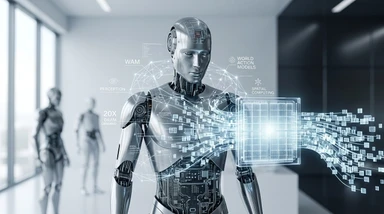
Embodied AI Hits Compute Bottleneck: Humanoid Robots Set to Drive 20x DRAM Demand Growth
The global humanoid robotics sector is undergoing a profound transformation—transitioning rapidly from scripted demonstration routines to autonomous decision-making in unstructured physical environments. However, as these machines become more intelligent, their appetite for real-time computational power and memory throughput is surging at an unprecedented rate.
1. Why Humanoid Robots Are Becoming "Memory Swallowing" Machines
Unlike traditional industrial automation arms operating on fixed, pre-programmed code, next-generation humanoids rely heavily on World Action Models (WAMs) and end-to-end multi-modal foundation models.
When interacting with real-world environments, a single robot must concurrently execute:
- High-Frame-Rate Spatial Perception: Fusing data streams across multiple high-resolution cameras, depth sensors, and LiDAR units simultaneously.
- Real-Time Physical World Prediction: Calculating microsecond-level balance adjustments, collision forecasting, and dexterous manipulation for deformable objects.
- On-Device LLM Inference: Processing natural language instructions and translating them into dynamic motor control policies locally.
This shift requires ultra-high memory bandwidth and cache capacity. Consequently, hardware architecture is shifting away from traditional low-power microcontrollers toward high-performance AI chipsets paired with massive onboard memory arrays.
2. Benchmarks Shift: From "Gymnastics" to Reliability
International research institutions and industry analysts highlight a critical shift in how humanoid performance is evaluated:
The Past Focus
High-explosive, athletic demonstrations such as backflips, sprinting, and boxing that look impressive in promotional videos.
The New Priority
Mean Time Between Failures (MTBF) and task completion rates in unstructured everyday scenarios (e.g., folding flexible garments or sorting unsorted items without error).
To bridge the gap between simulation environments and physical reality, global developments are increasingly relying on open-source datasets containing millions of real-world trajectory logs to enhance generalization capabilities across diverse robot platforms.
3. Strategic Takeaway for Tech Ecosystems
The commercial viability of humanoid robotics is rapidly expanding beyond mechanical engineering into a broader hardware supply chain revolution. From high-density DRAM and edge-NPU processors to high-precision harmonic drives and tactile sensors, humanoids are positioned to become the third major pillar of smart hardware terminals—following smartphones and electric vehicles.