


Z-Arm XX42E & XX50 Four-Axis SCARA Robots for Benchtop Cells
Bewertung schreiben
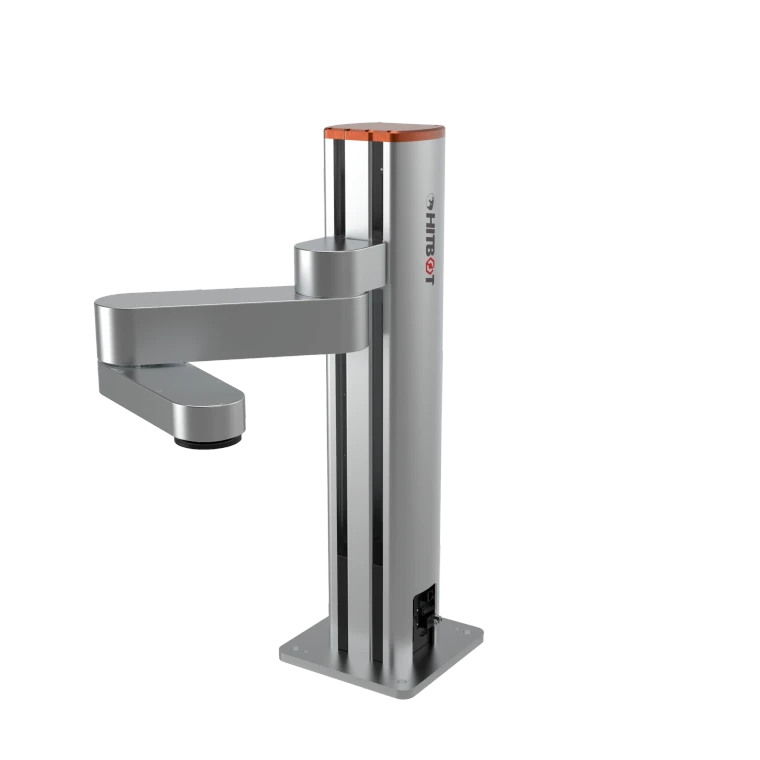
Z-Arm XX42E & XX50 Four-Axis SCARA Robots for Benchtop Cells
Product Overview
The Z-Arm XX42E and Z-Arm XX50 are the two middle sizes in HITBOT's four-axis SCARA line, both built for bench cells rather than floor-mounted workstations. The XX42E is the compact one: 420 mm of reach from a 220 + 200 mm arm pair, a 210 mm Z stroke, 2 kg rated payload and ±0.03 mm repeatability, on a 200 × 200 mm base at 18 kg and 566 mm tall — running from 24 V DC.
The XX50 is one size up: 500 mm of reach, a 410 mm Z stroke, 4 kg rated at ±0.05 mm, 28 kg and 830 mm tall on 48 V DC. It shares its base pattern and its flange with the XX60, so a cell built around an XX50 can be re-armed with a 600 mm machine without re-drilling the bench. Both run the same controller architecture, the same software and the same I/O set.
Key Features
420 mm or 500 mm Reach
220 + 200 mm arms on the XX42E, 275 + 225 mm on the XX50. Z stroke is 210 mm and 410 mm, and the R axis turns ±1080° without a mechanical stop on both.
±0.03 mm on the Small One
The shorter arm is the tighter arm: ±0.03 mm on the XX42E against ±0.05 mm on the XX50. Cycle times are 2.066 s and 2.370 s — shorter travel, shorter cycle.
18 kg on a 200 mm Base
The XX42E is 566 mm tall on a 200 × 200 × 10 mm plate with a 160 × 160 mm hole pattern, drawing 500 W at 24 V DC. It fits on a bench that was never designed for a robot.
Collision Detection, Per the Sheet
HITBOT lists collision detection as fitted on the XX42E and blank on the XX50. Drag teaching, hard e-stop and USB debugging are on both, with 9 + 3 isolated inputs and 8 in / 8 out at the forearm.
Application Areas
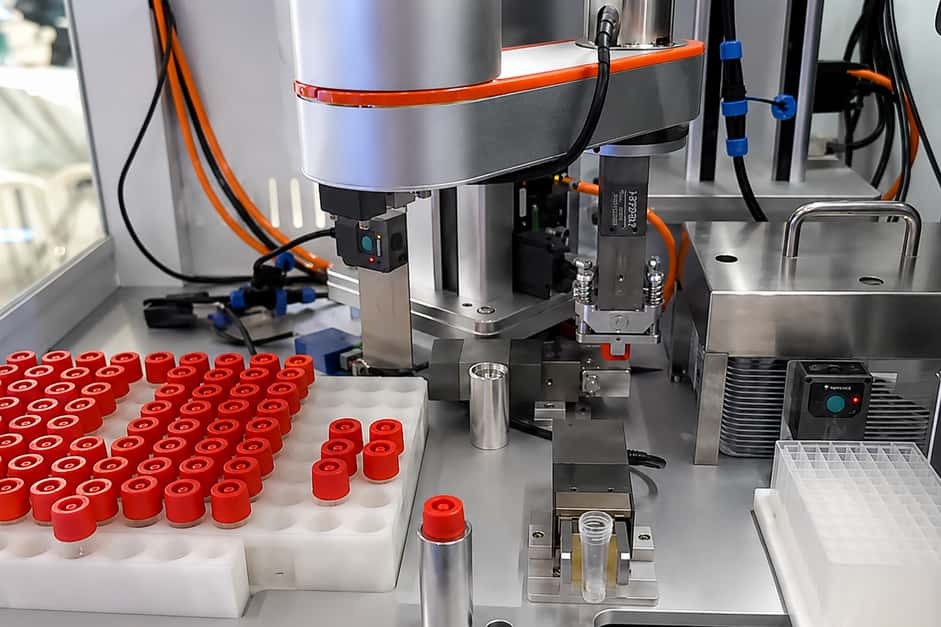
Micro-assembly and screw fastening in 3C electronics; adhesive and sealant dispensing; laboratory liquid handling, vial capping and tube transfer; test-handler loading; small press and tester tending; PCB depanelising and inspection; university and R&D benches where the cell is rebuilt each semester. Both arms are indoor units specified to 0–45 °C and 20–80 % RH non-condensing. No IP rating is published for either, so neither is a washdown or machine-shop arm.
Model Lineup
Compact · 2 kg
Z-Arm XX42E
420 mm reach · 2 kg rated · ±0.03 mm · 2.066 s · 500 W / 24 V · 18 kg
For the cell that has to go where there is no room: a fume hood, a laminar bench, a test station beside an operator. Smallest base in the range at 200 × 200 mm, tightest repeatability, and the only one of the two with collision detection listed.
Mid-size · 4 kg
Z-Arm XX50
500 mm reach · 4 kg rated · ±0.05 mm · 2.370 s · 1,000 W / 48 V · 28 kg
For the cell that has to reach across a conveyor or carry a gripper with some mass to it. Same base pattern and flange as the XX60, so it is the natural first step on a line that may later need 600 mm of reach.
Gallery


Product Description
The 200 mm Base Is the Whole Point
Most arms in this class assume a machine frame. The XX42E assumes a bench: a 200 × 200 mm plate, four M8 screws on a 160 × 160 mm pattern, 18 kg, 566 mm tall, 500 W at 24 V DC. That is a footprint you can put beside an operator, inside a fume hood, or on the end of an existing test station without building anything.
The Z axis is 210 mm as standard and available in steps — 0.11, 0.21, 0.31, 0.41 and 0.51 m — so the working height is chosen at order rather than shimmed on site. A short arm is also a stiff arm: ±0.03 mm repeatability is the best figure in the range.


One Size Up, Same Bolt Pattern
The XX50 adds 80 mm of reach and doubles the payload to 4 kg rated, and it does it on the 250 × 250 mm base and the XX60 flange. That is the detail worth checking before you buy either machine: a cell laid out for an XX50 can be re-armed with a 600 mm XX60 later without moving a single anchor bolt.
It also brings the 48 V platform, 1,000 W, and an official Z-axis range that runs from 0.1 m to 2 m on custom orders. Cycle time goes to 2.370 s and repeatability to ±0.05 mm — the trade for the longer arm, not a downgrade in build quality.
What Ships and What Does Not
Neither arm arrives with a gripper, a camera or a safety device. The XX42E flange matches the domestic Z-Arm 2140 range, the XX50 matches the XX42 range, and both bring out 8 in / 8 out at the forearm plus a dedicated gripper port that takes a pulse or an RS485 signal — standard cable is 23 AWG unshielded, with two 4 mm air tubes as an option.
Hard e-stop and USB debugging are standard. What is not published, on either model: IP rating, noise figure, and any force limit or safety category. Collision detection is listed only on the XX42E, so the safety case still has to be documented per cell rather than assumed from the datasheet.

ROI & Operational Value
1,740 or 1,520 cycles an hour, arm-only. Straight from the quoted 2.066 s and 2.370 s. The shorter arm wins on cycle as well as on accuracy, which is why the small cell is usually the faster cell — real output drops once transfer and vision are added, but the ranking holds.
50 % payload headroom on the XX42E, 25 % on the XX50. Rated 2 kg against 3 kg maximum, and 4 kg against 5 kg. A gripper and its air line come out of that, so size the tool against the rated figure — the maximum is a limit, not a target.
18 kg, four screws, 24 V. One person positions the XX42E, and the low-voltage supply means the power side of the install is a brick rather than a panel. That is what lets a robot go into a lab or a test bay that would never get a machine-room budget.
A range with one bolt pattern. XX50 and XX60 share base and flange; XX42E shares its flange family with the domestic 2140. Growth up the range does not mean rebuilding the cell — it means re-arming it.
Technical Specifications
| Parameter | Z-Arm XX42E | Z-Arm XX50 |
|---|---|---|
| Kinematics | ||
| Axis 1 Arm Length | 220 mm | 275 mm |
| Axis 1 Rotation | ±90° | ±90° |
| Axis 2 Arm Length | 200 mm | 225 mm |
| Axis 2 Rotation | ±164° (option 15–345°) | ±164° (option 15–345°) |
| Z-Axis Stroke | 210 mm | 410 mm |
| R-Axis Rotation | ±1080° soft limit / ±170° mechanical | ±1080° soft limit / ±170° mechanical |
| Degrees of Freedom | 4 | 4 |
| Performance | ||
| Linear Speed | 1,220 mm/s at 2 kg | 1,400 mm/s at 4 kg |
| Cycle Time | 2.066 s | 2.370 s |
| Repeat Positioning Accuracy | ±0.03 mm | ±0.05 mm |
| Rated Payload | 2 kg | 4 kg |
| Maximum Payload | 3 kg | 5 kg |
| Electrical & Control | ||
| Rated Power | 500 W | 1,000 W |
| Input Voltage | 110–220 V, 50/60 Hz | 110–220 V, 50/60 Hz |
| Output Voltage | DC 24 V | DC 48 V |
| Communication | Ethernet | Ethernet |
| Physical & Mounting | ||
| Overall Height | 566 mm | 830 mm |
| Weight (bare, standard stroke) | approx. 18 kg at 210 mm | approx. 28 kg at 410 mm |
| Base Dimensions | 200 × 200 × 10 mm | 250 × 250 × 15 mm |
| Mounting Holes | 160 × 160 mm, 4 × M8 × 20 | 200 × 200 mm, 4 × M8 × 20 |
| Custom Z-Axis Height | 0.11 / 0.21 / 0.31 / 0.41 / 0.51 m | 0.1–2 m |
| Operating Environment | 0–45 °C, 20–80 % RH non-condensing | 0–45 °C, 20–80 % RH non-condensing |
| I/O & Interface | ||
| Digital I/O (isolated) | 9 + 3, plus forearm expansion 8 in / 8 out; gripper port pulse or RS485 | 9 + 3, plus forearm expansion 8 in / 8 out; gripper port pulse or RS485 |
| Analog I/O (4–20 mA) | — | — |
| Reserved Interface | Standard: cable gland, 2 × 4×23 AWG unshielded. Option: 2 × φ4 mm air tube | Standard: cable gland, 2 × 4×23 AWG unshielded. Option: 2 × φ4 mm air tube |
| Safety & Programming | ||
| Collision Detection | Yes | — |
| Drag Teaching | Yes | Yes |
| Hard Emergency Stop | Yes | Yes |
| USB Debug / Online Upgrade | Yes | Yes |
| Base Compatibility | Same base as Z-Arm XX42 | Same base as Z-Arm XX60 |
| Flange Compatibility | Z-Arm 2140 flange | Z-Arm XX42 flange |
— means the manufacturer publishes no value for that item; it does not mean zero or unsupported. Cycle times are arm-only, quoted without part transfer or vision time.
The XX50's custom Z range is the one point where the two sources disagree: HITBOT's own XX50 page gives 0.1–2 m, the older comparison table gives 0.1–1 m. We quote the manufacturer's current figure and will confirm your length in writing before order. The XX42E has no separate page on hitbot.cc — its figures come from HITBOT's two-model comparison table, and its flange is listed against the domestic Z-Arm 2140.
Frequently Asked Questions
XX42E or XX50 — which one do I need?
Ask what has to be reached and what has to be carried. If everything sits inside a 420 mm radius and the tool weighs under 1.5 kg, the XX42E is the better arm: ±0.03 mm, a 200 mm base that will sit on a bench, 18 kg, 24 V. If the cell has to reach across a conveyor or hang a heavier gripper, the XX50's 500 mm reach and 4 kg rating settle it — and its base and flange are the XX60's, which matters if the line may grow.
Why does the smaller arm have the better accuracy?
Because it is shorter and lighter. ±0.03 mm on the XX42E against ±0.05 mm on the XX50 is a function of arm length and structural stiffness, not of a better encoder. It also turns a faster cycle — 2.066 s against 2.370 s — because the arm has less distance to travel. The trade is payload: 2 kg rated instead of 4 kg.
Does the XX42E really run on 24 V?
That is what the specification says: 500 W rated, 110–220 V AC in, 24 V DC out — while the XX50 is 1,000 W and 48 V. In practice it means the arm can be powered from a low-voltage supply rather than a machine panel, which is what makes it viable on a laboratory or test bench. Confirm your supply with us before ordering, because the arm's current draw at peak is not published.
Is collision detection fitted to both?
No. HITBOT lists collision detection as fitted on the XX42E and leaves the row blank for the XX50 — the same blank appears for the XX60 and XX60B. Neither model publishes a force limit or a safety category, so treat collision detection as one input to the risk assessment, not as a substitute for guarding. We will get the safety documentation for the exact model you buy.
Can it go inside a fume hood or on an existing bench?
Physically yes for the XX42E — 18 kg, 566 mm tall, a 200 × 200 mm plate on a 160 × 160 mm hole pattern. Two checks first: the bench top has to take the reaction torque of a 420 mm arm at 1,220 mm/s, and the hood has to have the headroom for the Z stroke you order. Send us the bench drawing and we will check both against the mounting pattern.
What grippers fit, and what is in the box?
The XX42E flange matches the Z-Arm 2140 range and the XX50 matches the XX42 range, so HITBOT's electric and pneumatic grippers bolt on directly; third-party tools need an adaptor plate. Both arms bring out 8 in / 8 out at the forearm plus a gripper port for pulse or RS485, with 23 AWG cable standard and two φ4 mm air tubes as an option. In the box: the arm, the power supply, the mounting screws. Not in the box: gripper, camera, safety device, cell frame.
Request a Quote
Send us the reach you need in X-Y, the tool weight, the working height and whether the cell sits on a bench or a frame. We will size the XX42E against the XX50, and quote the gripper, the air kit and the mounting plate with it.
Contact UsAbout Robotmall
Robotmall is a global B2B robotics platform connecting manufacturers, technology partners and businesses worldwide. We support robot sourcing, solution evaluation, deployment coordination and after-sales services.

- Models:
- XX42E / XX50|Reach=220+200 / 275+225 mm|Z Stroke=210 / 410 mm|Payload=2 / 4 kg rated|Repeatability=+/-0.03 / +/-0.05 mm|Cycle=2.066 / 2.370 s|Power=500 W 24V / 1000 W 48V|Weight=18 / 28 kg|Base=200x200 / 250x250 mm|Collision Detection=XX42E only


