

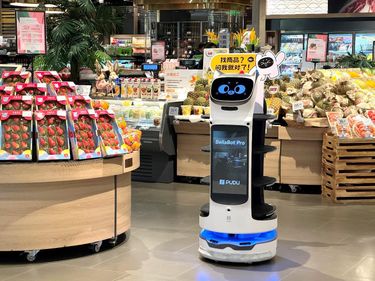
The Robot That Delivers Your Food — And Sells Your Menu
The Robot That Delivers Your Food — And Sells Your Menu
Restaurants face a 30–40% server vacancy rate. The BellaBot Pro doesn't just fill the gap — it turns every delivery run into a revenue opportunity.
By Robotmall Editorial · June 17, 2026 · 5 min read
The math is brutal: labor costs eat 30–35% of restaurant revenue, and 30–40% of server positions remain unfilled (BLS, 2024). Full-service restaurant staffing is still 4% below pre-pandemic levels. California fast-food wages hit $20/hr in 2024 — and more states are following.
Operators aren't choosing between robots and humans. They're choosing between understaffed shifts and robot-assisted ones. The BellaBot Pro from PUDU Robotics was built for exactly this moment — a delivery robot that also generates ad revenue every time it moves.
Why Now: The Market Behind the Momentum
The global restaurant service robot market was valued at $1.46B in 2025 and is projected to reach $6.82B by 2035 (Emergen Research). Delivery robots are the fastest-growing segment, and Asia-Pacific holds 42% of the market — but North America is accelerating fast.
| Metric | Data | Source |
|---|---|---|
| Market Size (2025) | $1.46B | Emergen Research |
| Market Size (2035) | $6.82B | Emergen Research |
| CAGR 2025–2035 | 16.7% | Emergen Research |
| PUDU global deployments | 130,000+ units / 85+ countries | PUDU / Strait Times |
| Robot reduces server trips | 20–35% | Bear Robotics / Industry data |
Server vacancy rates sit at 30–40%. California's $20/hr minimum for fast-food workers makes a robot that costs $700–$1,500/month to lease cheaper than a single part-time hire. The ROI isn't theoretical — it's arithmetic.
One Robot. Two Revenue Streams.
Most delivery robots save labor. The BellaBot Pro goes further: its built-in 18.5" advertising screen turns every walk through the dining room into a branded impression — menus, promos, loyalty programs, or partner ads. That's delivery savings + ad revenue from the same unit.
Inside the BellaBot Pro
Future Trends: What's Coming Next
The restaurant robot market is still in its Innovator phase in most Western markets — which means first-movers capture the most durable advantage. Three trends are accelerating adoption:
1. Wage legislation keeps climbing. Multiple US states are pushing toward $20–22/hr for food-service workers. At those rates, a robot at $700–$1,500/month pays for itself vs. a single hire within 3–6 months.
2. Advertising robots create a new revenue category. The BellaBot Pro's ad screen isn't a gimmick — it's a programmable digital signage platform that generates impressions while doing operational work. Think of it as a roaming DOOH (digital out-of-home) asset that also delivers food.
3. Full-robot hospitality is here. In June 2026, PUDU and Shenzhen CTID launched the world's first full-scenario robot-serviced hotel — from check-in to room service to housekeeping, all handled by PUDU robots. This is the blueprint for multi-robot hospitality operations globally.
The question is no longer "can a robot replace a server?" It's "can you afford to run a restaurant without one?" — 20–35% fewer server trips, 6 service modes from a single unit, and an ad screen that pays for itself. Early adopters aren't experimenting. They're compounding advantages.
"Every restaurant that deploys a BellaBot Pro isn't just solving a labor gap — it's turning a cost center into a revenue center."
— Robotmall Editorial, June 2026Ready to Put BellaBot Pro to Work?
Delivery. Advertising. Celebrations. One robot, six modes, zero environment modification.