

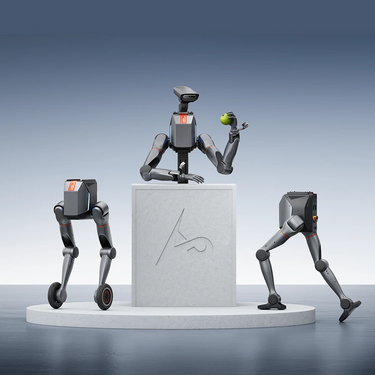
LimX Dynamics dropped the TRON 2 in December 2025 and quietly rewrote the economics of embodied robotics. Three configurations — dual arms, wheeled legs, bipedal — in one modular body. Starting at $7,400. That's not a typo.
Most ROI conversations around humanoid robots still orbit the $100K–$250K range. But at this price point, the math changes entirely. We pulled data from actual deployments across warehousing, manufacturing, and research labs to answer the question that actually matters: when does it pay for itself?
"$7,400 isn't the price of a robot. It's the price of a bet on embodied intelligence — and the numbers suggest that bet closes fast."
What You're Actually Buying
3-in-1 Modular Body
Swap between arms, wheeled legs, and bipedal legs. One robot does research, inspection, and logistics — no need for three separate purchases.
7-DoF Dual Arms
Human-range dexterity; 70 cm reach; 10 kg payload. Enough for assembly, sorting, and tabletop manipulation tasks.
4-Hour Battery Life
Longest in its class. Most competitors run 1–2 hours. Charges in under 2. Auto-docking keeps it going across shifts.
Python / ROS2 / Isaac Sim
Open SDK, preloaded VLA models. From unboxing to real-machine deployment in about two hours. No PhD required.
LimX didn't build a toy or a dev kit. TRON 2 is a general-purpose base — one platform, multiple jobs. For teams buying separate rigs for VLA research, mobile manipulation, and locomotion, a single TRON 2 replaces $49K–$98K worth of hardware.
The Market Behind the Momentum
According to IDC, global embodied AI robot shipments hit 18,000 units in 2025 and are projected to surpass 50,000 in 2026. China accounts for 45%+ of that volume, with the domestic market forecast at $55 billion by 2030 (China DRC). LimX Dynamics closed a $200M Series B in early 2026 — with JD.com, NIO Capital, and Stone Venture all writing checks. The signal is unmistakable.
Where the ROI Comes From
The formula is simple: (Annual Savings + Revenue Uplift) ÷ Total Cost. What changes across scenarios is how fast that numerator grows.
Real Deployments That Prove the Case
Warehousing
Geek+ Gino 1 replaces 3 human pickers per unit, saving ~$62K/year. TRON 2 costs 1/16 as much and handles similar tasks with 30 kg payload.
Payback: < 2 yearsManufacturing
Zhiyuan robots deliver 1.6× human efficiency at 99.5% task success. NIO's smart factory cut defects by 40% after introducing embodied AI.
Annual ROI: 25–35%Research
A single TRON 2 replaces VLA, manipulation, and locomotion platforms that cost $49K–$98K collectively. Hardware savings alone pay it off in under 6 months.
Saved: $28K–50K+IDC Market Data
Embodied AI shipments grew 180% YoY. The $7K price point is positioned exactly where IDC predicts mass adoption begins — below $10K.
50K+ units in 2026How It Stacks Up
At $7,400, TRON 2 doesn't compete on raw specs — it competes on accessibility × flexibility. Here's the field:
Digit runs longer. Gino 1 never stops. But neither swaps form factors mid-deployment. If your use case changes — or you're still figuring out your use case — TRON 2 is the only one on this list that doesn't lock you in.
Who Pulls the Trigger, Who Waits
Worth It Today
- Research labsjuggling 3+ robot platforms
- Warehouseswith structured picking and transport
- Multi-floor factoriesneeding stair-capable inspection
- Robotics programsteaching VLA, manipulation, locomotion
Watch and Learn
- Restaurants & hotels— unstructured environments
- Continuous 24/7 lines— 4-hour battery needs strategy
- Sub-millimeter precision— wait for LimX's Oli platform