

The Staffing Crisis Is Real: Why the Pudu SH1 Is No Longer Optional
A Workforce in Freefall
The U.S. janitorial industry is facing a projected shortage of 400,000 skilled workers by 2025. Turnover hits 200% annually in commercial cleaning. The industry is losing $1 billion a year to unfilled roles. In 2026, approximately 40% of cleaning businesses are turning down contracts because they cannot staff them. Labor, not demand, is now the primary constraint on growth.
The numbers tell a simple story. Even if you could hire enough people, the economics are shifting. Commercial cleaning labor costs have risen 15–20% since 2022 and are still climbing. For facility managers, the question is no longer "should we automate?" It is "how fast can we start?"
The Pudu SH1: One Robot, Three Jobs
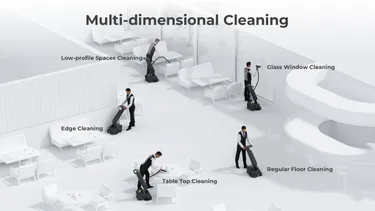
Traditional floor cleaning needs three separate machines — a sweeper for debris, a scrubber for hard floors, and a vacuum for carpets. The Pudu SH1 combines all three in a single autonomous platform. For a facility manager, that means one purchase order, one learning curve, and one maintenance contract instead of three.
| Feature | Specification | Why It Matters |
|---|---|---|
| 3-in-1 Function | Sweep + Scrub + Vacuum | Replaces three separate machines in one unit |
| Navigation | VSLAM + LiDAR | Autonomous pathing — no rails, no pre-mapping needed |
| Lifting System | PLC-controlled adaptive lift | Maintains optimal brush pressure on uneven floors |
| Clean Water Tank | 25 L | Large capacity for long continuous runs in commercial spaces |
| Recovery Tank | 25 L | Hygienic dirty-water separation, easy to empty |
| Water Recycling | Closed-loop system | Uses less water — critical for high-frequency cleaning |
Where the Demand Is Hitting First
Hospitals, airports, shopping malls, and office complexes are the early adopters — not because they are tech-forward, but because they cannot find enough staff. A single SH1 can cover up to 1,500 m² per hour with consistent quality. Run it overnight, and it delivers a clean floor every morning without a single human on-site.
Water recycling is another selling point that matters. In regions with water restrictions, or facilities that clean continuously (hospitals, food processing plants), a closed-loop system that reuses clean water is not a nice-to-have. It is a regulatory and cost advantage.
The Bottom Line
The commercial cleaning robot market is growing from $2.84 billion to nearly $7 billion by 2033. The driver is not cool technology — it is a labor crisis that is not going away. The Pudu SH1 is built for exactly this moment: 3-in-1 coverage, autonomous navigation, water recycling, and commercial-grade durability.
For facility managers staring at open headcount and rising labor costs, the math is straightforward. A robot works 24/7, never quits, never calls in sick, and pays for itself in labor savings within 12–18 months. The only question left is how many you need.
Ready to see the Pudu SH1 in action?
View Pudu SH1 on robotmall →robotmall — a global robotics marketplace by Orbio Systems, connecting cutting-edge technology with real human needs. Explore more at robotmall.com.
Sources: DataIntelo, Verified Market Reports, ISSA, CleanQuote, GoSitBack 2026 Industry Report.