

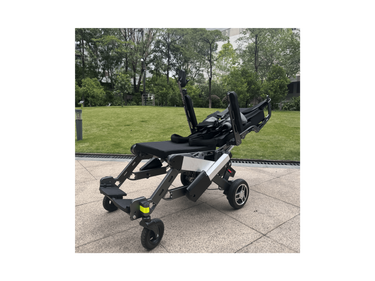
Stand Up, Move Forward: How Electric Walking Aid Robots Are Reshaping Rehab
Stand Up, Move Forward: How Electric Walking Aid Robots Are Reshaping Rehab
The Scale of the Problem
Globally, 15 million people suffer a stroke each year. Two-thirds are left with mobility impairment. China alone has over 300 million citizens aged 60+. For these people, the simplest acts — standing up, walking across a room — are daily battles. And the traditional answer has barely evolved: manual wheelchairs, human lifting, and fixed-location rehab equipment that patients can only access a few times a week.
The market is waking up. The global eldercare assistive robots market hit $3.4 billion in 2025 and is projected to reach $9.8 billion by 2033 — a 14.2% CAGR. In China, the rehabilitation robotics segment alone surpassed ¥1.6 billion last year. Physical assistive robots now claim 55% of the eldercare robot market. This is not a niche anymore.
The HKXZ-2101: Three Functions, One Device
Most products on the market do one thing: a wheelchair moves you, a standing frame lifts you, a gait trainer walks you. The HKXZ-2101 combines all three. It is a powered sit-to-stand lift, a self-driving mobility device, and a gait rehabilitation system in a single platform.
| Feature | Specification | Why It Matters |
|---|---|---|
| Electric Lift | 490 mm stroke | Safe, unassisted sit-to-stand — restores patient autonomy |
| Dual Motors | 2 × 250 W | 6 km/h top speed; instant stop on release |
| Gait Training | Safety harness system | Guided walking practice for neural re-learning |
| Dual Control | Joystick + wireless remote | Patient freedom with caregiver override |
| Range | 15–20 km per charge | Full-day use without range anxiety |
| Backrest | 180° stepless recline | Active training ↔ rest, seamless transition |
From Hospital to Home — The Big Shift
Ten years ago, walking-assist robots were hospital-only equipment, priced for institutional budgets. Today, lighter materials (carbon fiber), smarter control (AI-driven gait adaptation), and better batteries are driving costs down. The fastest-growing segment is home-use — and the economics are compelling.
In the U.S., a full-time home caregiver averages $60,000/year. In Chinese tier-1 cities, a live-in caregiver runs ¥8,000–12,000/month. A single rehabilitative robot, used daily over several years, delivers a clear return on investment — while giving the user something a caregiver cannot: independence.
Insurance coverage is expanding. Medicare is beginning to reimburse exoskeleton devices in the U.S. Shanghai's 2025 three-year action plan explicitly supports rehab robotics development and distribution. The payment infrastructure is catching up to the technology.
The Competitive Landscape
The wearable exoskeleton space is led by ReWalk, Ekso Bionics, and Cyberdyne — clinically validated but expensive and complex. Rollator-style walking assistants from Panasonic, Honda, and Shenzhen-based startups are pushing into hospital procurement. Where does the HKXZ-2101 sit? At the intersection: powered standing + gait training + autonomous mobility. It is neither a pure exoskeleton nor a simple powered wheelchair. It serves the gap between inpatient rehab and everyday home life — the largest addressable market.
The Bottom Line
Three forces are converging: an irreversible demographic shift toward aging populations, a rigid, non-optional demand for rehabilitation, and accelerating technology that is finally making robots accessible. This is the moment when walking-assist robots stop being "futuristic" and start being infrastructure.
The HKXZ-2101's tagline says it best: Stand Up, Move Forward. For hundreds of millions of people, that is not a slogan — it's the whole goal.
Help someone stand up again.
View HKXZ-2101 on Robotmall →Robotmall — a global robotics marketplace by Orbio Systems, connecting cutting-edge technology with real human needs. Explore more at robotmall.com.
Sources: Grand View Research, 360iResearch, 中商产业研究院, Emergen Research, Persistence Market Research.