

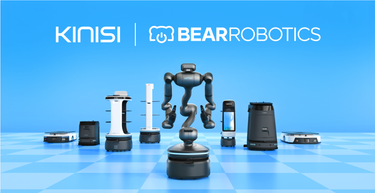
Bear Robotics Acquires Kinisi: Two Paths to Physical AI
16,000 deployed service robots + a wheeled humanoid platform. Bear Robotics didn't buy talent. It bought time — and revealed a fundamental split in how the US and China are building the physical AI stack.
Deal Snapshot
Why This Matters
Bear Robotics runs 16,000+ service robots across hotels, hospitals, and malls. Its robots move. They deliver. They clean. But they can't pick things up.
Kinisi's KR1 is a wheeled humanoid — not bipedal, not acrobatic. It rolls on flat floors and uses manipulation arms to pick, place, sort, and move objects. No facility retrofit needed. Plug-and-play in warehouses and industrial floors.
The real asset isn't the hardware. It's the data flywheel. Kinisi built low-cost gloves that capture human hand motions as training data, without burning robot runtime. Combined with Bear's 16,000-unit fleet generating real-world operational data daily, the combined training pipeline moves faster than either could alone.
And the compatibility is already there — Kinisi built its stack on top of Bear's navigation platform from day one. Post-merger, delivery bots, cleaning bots, and KR1 humanoids run on one unified platform, not a patchwork of vendor silos.
US vs China: Two Playbooks
This deal would likely look very different in China. The strategic split is stark:
| Dimension | Bear Robotics (US) | Unitree / AgiBot (China) |
|---|---|---|
| Strategy | Acquire to fill capability gaps | Vertical integration + scale |
| Humanoid Form | Wheeled (KR1, no retrofit needed) | Bipedal (H1/G1, Expedition A2) |
| Volume Target | No public target; RaaS-first | Unitree: 75K units/year; AgiBot: 10K shipped |
| Data Play | 16,000-unit fleet + glove capture | Mass deployment for scene data |
| Capital | Undisclosed M&A | Unitree IPO filing; AgiBot multi-round funding |
| Team | Acquire entire team, keep Bristol hub | Rapid hiring, in-house cultivation |
Neither is wrong. The US path is optimized for proven commercial fleets and service expansion. The China path is optimized for manufacturing labor gaps and government-mandated deployment targets (MIIT's 10,000-unit real-world training push by end of 2026).
What Buyers Should Watch
1. Wheeled humanoids are the pragmatic choice for existing facilities. If your warehouse has flat floors, you don't need a bipedal robot doing backflips. You need something that rolls in and starts picking.
2. "One platform, multiple form factors" is the real buying criteria. Bear's value proposition isn't a single robot. It's delivery + cleaning + manipulation all orchestrated on one stack. That matters more than any spec sheet.
3. RaaS is creeping into manipulation. Kinisi already had paid pilots in manufacturing, logistics, and retail before the acquisition. Humanoid manipulation isn't just a CapEx purchase anymore. It's becoming a service you subscribe to.
The Bottom Line
NVIDIA is filling the safety layer (Halos for Robotics). OpenAI is building hardware in-house. Bear is buying the manipulation layer. The physical AI stack is coming together fast — just through different routes on different continents.
For global hardware distributors like RobotMall, the signal is clear: the future isn't one product category. It's multi-form-factor, multi-scenario, unified-platform deployments. Whether your customer needs a lawn mower, a pipe inspector, or a humanoid picker, the infrastructure that ties them together is where the real value lives.
(Images sourced from the internet. Please contact me for removal if there is any copyright infringement.)